
Tool changing time directly affects CNC machining efficiency. If your machine stops frequently for manual tool replacement or slow tool changes, production time and machining consistency will suffer.
This is why Automatic Tool Changers (ATCs) have become an important part of modern CNC machines. They help reduce downtime, improve automation, and support multi-process machining in one setup.
But not all automatic tool changers are the same.
Different ATC types offer different tool capacities, changing speeds, and machine structures. Some are better for small workshops and simple machining, while others are designed for high-speed production and complex parts.
In this article, you'll learn the common types of automatic tool changers in CNC machines, how they work, and the advantages and limitations of each type.
What Is an Automatic Tool Changer in a CNC Machine?
An Automatic Tool Changer (ATC) is a system used in CNC machines to change cutting tools during machining without manual operation. It helps the machine switch between different tools quickly, allowing multiple machining processes to be completed in one setup.
An ATC system usually consists of:
- Tool magazine
- Tool changing arm
- Tool holders
- Spindle interface
- CNC control system
During machining, the CNC program automatically selects the required tool from the tool magazine and exchanges it with the current tool in the spindle. This process only takes a few seconds and greatly reduces machine downtime.
Compared with traditional manual tool changing, automatic tool changers offer several important advantages:
- Faster machining cycles
- Reduced operator workload
- Higher machining efficiency
- Better machining consistency
- Support for unattended machining
- Easier multi-process machining
Today, automatic tool changers are widely used in vertical machining centers, horizontal machining centers, gantry CNC machines, and 5-axis machining centers, especially in industries that require high productivity and continuous machining operations.
Types of Automatic Tool Changers in CNC Machines
Different CNC machines use different types of automatic tool changers depending on machining complexity, tool capacity, and production requirements. Some ATC systems focus on lower cost and simple operation, while others are designed for high-speed and high-volume machining.
Below are the most common types of automatic tool changers used in CNC machines.
Umbrella Type Automatic Tool Changer
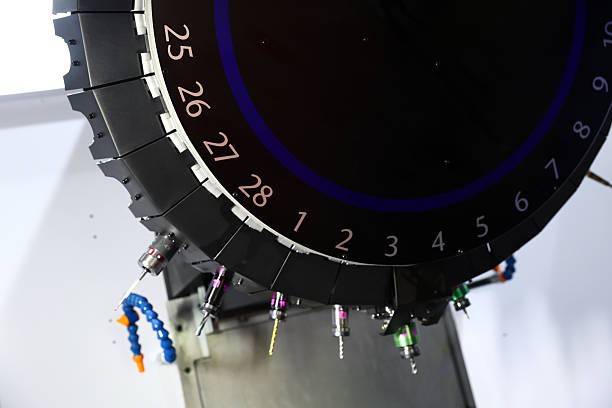
The umbrella-type ATC is one of the most common tool-changing systems used in small and medium vertical machining centers. The tools are arranged in a circular magazine similar to an umbrella shape, and the spindle directly exchanges tools with the magazine position.
Benefits:
- Simple structure
- Lower machine cost
- Easy maintenance
- Suitable for basic machining operations
Downsides:
- Slower tool-changing speed
- Smaller tool capacity
- Not ideal for complex machining
Arm Type Automatic Tool Changer
The arm type ATC uses a mechanical arm to automatically exchange tools between the spindle and the tool magazine. This type is widely used in medium and high-end CNC machining centers because of its fast tool-changing speed.
Common Sub-Types:
- Double Arm Type
- Exchanges tools faster
- Common in high-speed machining centers
- Single Arm Type
- Simpler structure
- Lower cost than double-arm systems
Benefits:
- Fast tool changing
- Higher production efficiency
- Supports larger tool magazines
- Better for automated machining
Downsides:
- Higher manufacturing cost
- More complex maintenance
- Requires more machine space
Chain Type Automatic Tool Changer
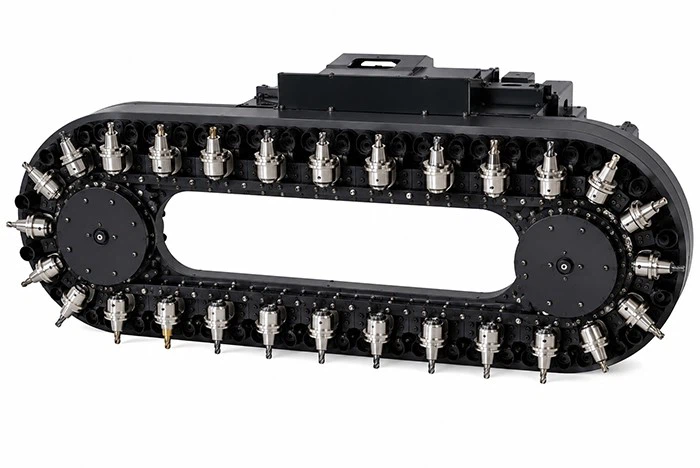
The chain-type ATC uses a chain-driven tool magazine to store a large number of tools. It is commonly used in horizontal machining centers, gantry machines, and large CNC systems.
Benefits:
- Large tool capacity
- Suitable for complex machining
- Supports long unattended operation
- Ideal for multi-process machining
Downsides:
- Larger machine footprint
- Higher maintenance requirements
- Higher system cost
Drum Type Automatic Tool Changer
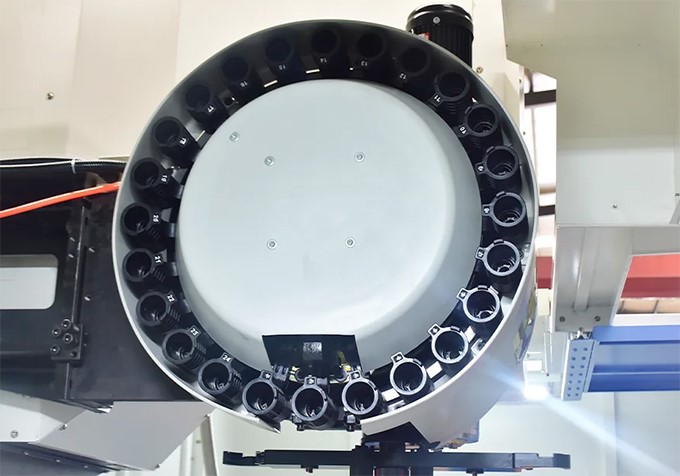
The drum-type ATC uses a rotating drum structure to store and index tools. It is designed for fast tool positioning and compact machine layouts.
Benefits:
- Fast indexing speed
- Compact structure
- Good for high-speed machining
Downsides:
- Limited tool storage capacity
- Less suitable for large tools
Linear Type Automatic Tool Changer
The linear type ATC stores tools in a straight-line arrangement beside the machine. It is commonly used in customized CNC systems or machines requiring special tool layouts.
Benefits:
- Flexible design
- Easy tool access
- Suitable for long tools
Downsides:
- Slower tool retrieval speed
- Requires more installation space
Automatic Tool Changer Types Comparison
|
ATC Type |
Structure |
Tool Change Speed |
Tool Capacity |
Advantages |
Limitations |
Common Applications |
|
Umbrella Type ATC |
Circular umbrella-style magazine |
Slow |
Small |
Low cost, simple structure, easy maintenance |
Slower tool changing, limited capacity |
Small VMCs, basic machining |
|
Arm Type ATC |
Mechanical arm exchanges tools |
Fast |
Medium to Large |
High efficiency, fast tool change, suitable for automation |
Higher cost and maintenance |
VMC, HMC, 5-axis machining centers |
|
Chain Type ATC |
Chain-driven tool magazine |
Medium to Fast |
Large |
Supports many tools, ideal for complex machining |
Large footprint, higher cost |
HMCs, gantry CNC machines |
|
Drum Type ATC |
Rotary drum tool storage |
Fast |
Medium |
Compact design, quick indexing |
Limited tool quantity |
High-speed CNC machines |
|
Linear Type ATC |
Straight-line tool arrangement |
Medium |
Medium to Large |
Flexible layout, suitable for long tools |
Requires more space |
Customized CNC systems |
How to Choose the Right Automatic Tool Changer
Choosing the right automatic tool changer depends on your machining requirements, production volume, and machine type. A larger or faster ATC is not always the best choice. The key is selecting a system that matches your actual production needs.
Based on Production Volume
If you mainly handle small batch production or simple machining tasks, an umbrella-type ATC is usually enough. It offers lower cost and simpler maintenance.
For mass production or continuous machining, arm-type and chain-type ATCs are more suitable because they enable faster tool changes and improved automation efficiency.
Based on Machining Complexity
Simple parts usually require fewer tools, so a smaller tool magazine is sufficient.
However, complex workpieces often involve drilling, tapping, milling, boring, and finishing in one setup. In this case, a larger tool capacity helps reduce manual intervention and improve machining continuity.
Based on Machine Type
Different CNC machines commonly use different ATC systems:
Vertical Machining Centers (VMC) → Umbrella type or arm type
Horizontal Machining Centers (HMC) → Chain type
5-Axis CNC Machines → High-speed arm type ATC
Gantry Machining Centers → Large-capacity chain type ATC
Choosing an ATC that matches the machine structure can improve stability and tool-changing efficiency.
Based on Tool Capacity Requirements
The required number of tools also affects ATC selection.
Production Requirement Recommended Tool Capacity
Simple machining 12–24 tools
General production 24–40 tools
Complex machining 40–60 tools
Automated production lines, 60+ tools
A larger tool magazine supports more machining operations, but it also increases machine size and cost.
Based on Maintenance and Budget
Some ATC systems are faster and more advanced, but they also require higher maintenance costs.
If your priority is lower investment and easier operation, a simpler ATC structure may be a better choice. For high-efficiency automated production, investing in a faster, higher-capacity ATC can improve long-term productivity.
FAQs
1. What is the purpose of an automatic tool changer in a CNC machine?
An automatic tool changer allows a CNC machine to switch cutting tools automatically during machining. It helps reduce manual operation, shorten downtime, and improve overall machining efficiency, especially in multi-process machining.
2. Which type of automatic tool changer is the fastest?
Arm-type automatic tool changers are generally the fastest because they use a mechanical arm to exchange tools quickly between the spindle and the tool magazine. They are widely used in high-speed and high-production CNC machining centers.
3. What is the difference between the umbrella type and the chain type ATC?
Umbrella-type ATCs are simpler, smaller, and more cost-effective, making them suitable for basic machining tasks. Chain-type ATCs support larger tool capacities and are better for complex machining and automated production environments.
4. How many tools should a CNC machine tool magazine have?
The required tool capacity depends on your machining process. Simple machining may only need 12–24 tools, while complex parts or automated production lines may require 40, 60, or even more tools for continuous machining.
5. Which industries commonly use large automatic tool changers?
Industries such as aerospace, automotive, mold manufacturing, energy equipment, and heavy machinery commonly use large-capacity ATC systems because they often require complex multi-process machining with many cutting tools.
6. What should you consider before choosing an ATC system?
You should consider machining complexity, production volume, required tool quantity, machine type, tool changing speed, maintenance requirements, and overall budget before selecting an automatic tool changer system.
Conclusion
Different types of automatic tool changers are designed for different machining needs. Some are better for simple and cost-effective production, while others are built for high-speed machining, large tool capacity, and continuous automated operation.
Choosing the right ATC not only improves tool-changing efficiency but also affects machining stability, production flexibility, and long-term productivity. Whether you are machining simple parts or complex multi-process components, understanding the differences between ATC systems can help you select a CNC machine that better fits your production requirements.
As machining demands continue to increase, many manufacturers are also upgrading to larger-capacity and faster ATC systems to improve automation and reduce downtime in daily production.