


Introduction
Computer numerical control, or CNC, has greatly changed the manufacturing industry for nearly all businesses. The modification of CTMs (computerized tool machines) has enabled them to make complex parts with incredible speed, exactness, and uniformity due to controls that are all computer-assisted. This, in turn, has led to the expansion and general average of large part production; the need for manual machination is now a thing of the past.
What sets apart improvement in CNC machining, in particular, is the introduction of 'more than 3' additional axes, which allows for advanced motion and manipulation. For example, the evolution from 3-axis to 4-axis and 5-axis machines has made it feasible to create new designs of mass production that have complicated core geometries and even faces that have curves.
This article will give CNC users a deeper understanding of the differences between 4-axis and 5-axis CNC as we compare their uniqueness, capabilities, deficiencies, cost of use, and most importantly, if these two are suitable for the user's intended use. Understanding these distinctions would allow one to effectively and efficiently choose the right CNC machine for optimum productivity, quality of parts, and good Return on Investment (ROI).
Understanding CNC Machining Basics
Before analyzing 4-axis versus 5-axis technology, it is helpful to understand some foundational concepts of CNC machining. CNC refers to computer numerical control, which is a manufacturing process that utilizes computer-controlled machine tools to automate the fabrication and shaping of raw materials like metal, plastics, wood, foam, and composites.
The CNC machine follows motion instructions programmed as G-code, allowing it to perform repetitive actions with a higher degree of consistency, speed, complexity, and precision compared to manual machining. By transitioning from purely manual control to computerized numerical control, manufacturers have greatly increased their design flexibility, production efficiency, and end-product quality.
Early CNC machining utilized only 3 axes of motion – the X, Y, and Z axes. This allowed movement along the linear planes as well as vertically, facilitating many fundamental manufacturing processes. However, the complexity of parts that could be produced was still limited.
By introducing additional axes of movement beyond the original three, CNC technology has rapidly evolved to meet rising demands. Mainstream adoption is currently centered on 4 and 5-axis configurations, which notably expand the capability to machine complex contours and geometries.
What is 4-Axis CNC Machining?
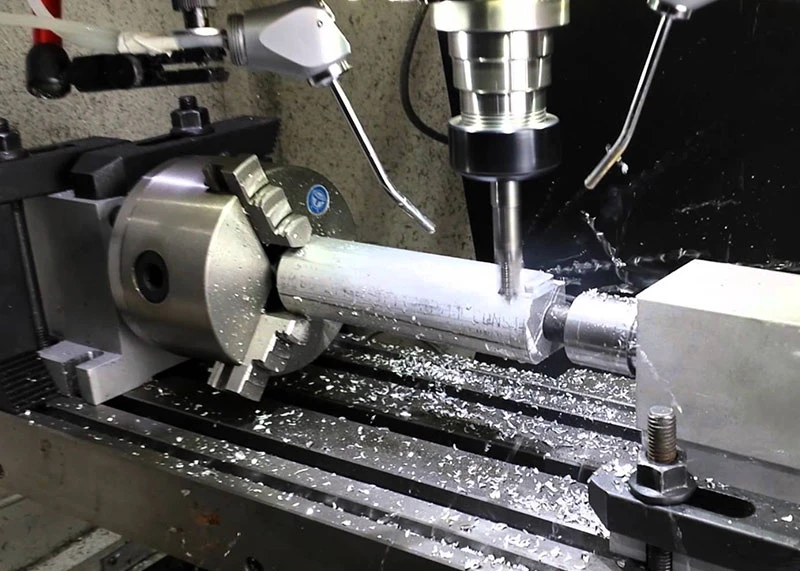
4-axis CNC machining incorporates an additional rotary axis beyond the standard 3-axis X, Y, and Z linear movements. This added axis – often labeled A, B, or C depending on orientation – provides rotational motion around the X, Y, or Z axes. For example, the part can spin around the Z-axis while the tool moves along the X and Y planes to machine elaborate curved surfaces.
Some common configurations of 4-axis CNC machining include:
X, Y, Z linear axes + A rotary axis
X, Y, Z linear axes + B rotary axis
X, Y, Z linear axes + C rotary axis
The four axes operate simultaneously during the machining process, with precise synchronization allowing complex geometries to be created. Parts can be rotated or pivoted as needed to access all surfaces and angles. The versatility of movement expands the range of manufacturable designs.
Advantages of 4-Axis CNC Machining
Incorporating a 4th axis of rotation brings notable advantages, including:
Cost-effectiveness – 4-axis machines have a lower initial purchase cost and operational expenses compared to 5-axis alternatives. For companies machining less complex parts, this improved affordability and return on investment can be an important consideration. Simplified kinematics also increase reliability and reduce maintenance timelines.
Suitable for a range of applications – While not able to match the most advanced 5-axis machine capabilities, 4-axis CNC technology still enables the fabrication of components with moderately complex geometries. The rotational movement facilitates the machining of contoured and angled surfaces. Parts like turbines, impellers, fans, and transmission gears are common applications.
Increased part complexity – The rotating fourth axis allows drilling or milling at compound angles that cannot be achieved on standard 3-axis machines. Parts with intricate porting, cavities, and recessed areas are able to be manufactured. CNC productivity is also improved by reducing the number of setups required.
Wide industry adoption – From aerospace components to medical devices and automotive parts, 4-axis CNC machining is ubiquitous across nearly every manufacturing sector. As technology has improved and costs have reduced, adoption has increased even for small-batch prototyping needs.
Limitations of 4-Axis CNC Machining
While 4-axis CNC machining certainly produces more complex components than 3-axis alternatives, some inherent limitations can be addressed by transitioning to 5-axis machines:
Restrictions in part complexity – The rotational movement in 4-axis machining is still restricted to a single axis. Simultaneously contouring multiple surfaces, especially at opposing angles, exceeds the capacity of 4-axis machines. 5-sided machining is often required to produce these geometries.
Positioning challenges – Since rotation is isolated on one axis, maneuvering parts into position for machining all required surfaces can require numerous setups and changeovers between machining operations. This increases production timelines and cost per part.
Reaching capability limits – Components like turbine blades, impellers, and other intricate designs are pushing the boundaries of 4-axis CNC. As complexity continues rising, inherent limitations of 4-axis machining will increasingly become a barrier to production. By upgrading to 5-axis systems, manufacturers gain access to a new tier of part complexity.
What is 5-Axis CNC Machining?
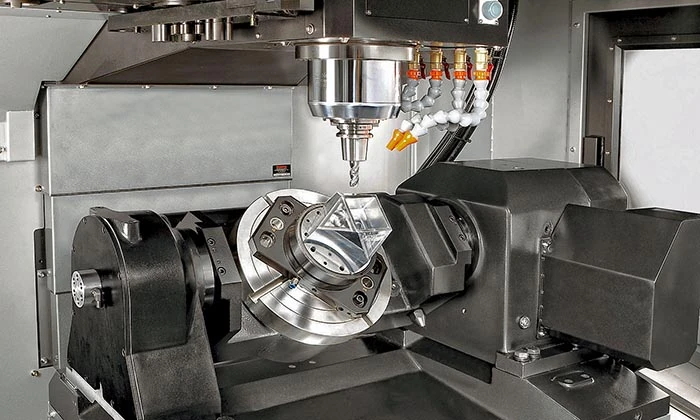
As the name indicates, 5-axis CNC incorporates an additional two rotary axes to provide more advanced part positioning flexibility compared to 4-axis. This facilitates uninterrupted contour machining across multiple sides of the part simultaneously.
In a 5-sided configuration, the standard X, Y, and Z linear axes are supplemented by two rotary axes labeled A and B. Typical examples include:
X, Y, Z, A, B
X, Y, Z, A, C
X, Y, B, C
By integrating dual rotary axes, components can be oriented along virtually any plane in space to expose the optimum surface for machining. Complex compound angles are able to be precision tooled in a single setup due to this multi-axis manipulation capability.
Advantages of 5-Axis CNC Machining
The ultra-flexible maneuverability of 5-axis CNC machines offers significant advantages:
Superior design complexity – 5-axis machining vastly expands the geometric complexity that can be manufactured by accessing parts from multiple sides/angles in one operation. Intricate designs like turbines, impellers, medical implants, and aerospace components can be produced cost-effectively.
Machining intricate geometries - Compound angles, complex contours, and 5+-sided part geometries unable to be produced on 3 or 4-axis machines can be readily fabricated on 5-axis CNC systems. The only limit is the imagination of the designer!
Faster production – By minimizing setup changes, 5-axis machining reduces production time significantly. Components often require just a single fixturing orientation to machine the complete design. This lessens fabrication costs and accelerates time-to-market for new products.
Improved surface finish – Uninterrupted machining along curved surfaces enabled by continuous 5-axis motion ensures optimal surface finish quality and dimensional precision. Removing repositioning eliminates surface inconsistencies.
Industry applications – 5-axis CNC capability is demanded across aerospace, power generation, oil/gas, automotive, construction, shipbuilding, and medical device manufacturing. As production volumes rise and designs grow increasingly complex across sectors, 5-axis adoption will continue expanding.
Potential Drawbacks of 5-Axis Machining
With greater capability comes increased complexity and costs. Considerations include:
Higher machine investment – The ultra-flexible kinematics and robust structural design of 5-axis CNC machines contribute to substantially higher base costs compared to 3 and 4-axis equipment. However, long-term ROI is superior for components requiring multi-axis machining.
Complex programming - To fully leverage the versatility of motion, machine programs require more sophisticated programming expertise to avoid collisions, fully optimize tool paths, and ensure precision. This requires personnel training investments.
More maintenance - The intricate mechanical design of 5-axis machines translates to more maintenance to ensure optimal performance. However, newer models continue improving in this regard. Regular calibration is critical.
Comparative Analysis: 4-Axis vs 5-Axis CNC
Now that we have covered the inner workings and capabilities of both technologies independently, we can analyze how they directly compare:

Performance Comparison
Precision capabilities – 5-axis CNC machines enable higher precision machining, especially along contoured surfaces. Eliminating multiple setups improves consistency. They are unmatched for ultra-complex parts.
Manufacturing complexity – 5-axis configurations can produce far more complex geometries by simultaneously accessing more sides of a part in a single operation. 4-axis kinematics cannot match this flexibility.
Surface finish – Continuous multi-axis contouring produces a smoother, higher quality surface finish over interrupted machining and changeovers typical in 4-axis operations.
Speed/efficiency – When considering comparable machines focused on complex parts, 5-axis CNC often requires less programming input, faster cycle times, and reduced labor due to single setup simplicity.
Cost Considerations
Machine investment - Upfront machine tool costs for 5-axis CNC equipment can range from 1.5X to over 3X higher than 4-axis alternatives depending on size and features. However, there are also 4 and 5-axis machines tailored to different budgets.
Operational costs – Additional axes of motion contribute to potentially faster wear on consumable tooling. Programming complexity also translates to increased production planning labor for 5-axis work. However, reducing setups saves on fixtures/tooling.
Long-term value – For small production lots, 4-axis machines provide better value. But when machining complex components in higher volumes, the reduction in setups and faster cycle times drive substantially lower costs per part, delivering long-term ROI advantages.
Technological Complexity
Programming - G-code programming for 5-axis CNC machining requires greater expertise to fully utilize the capabilities while optimizing cycle efficiency and avoiding tool/part collisions. Simulation software is very valuable for proving out programs.
Skills development - Machine operators need additional training for successful 5-axis operation compared to 3 or 4-axis equipment. Areas like setup, fixturing, preventative maintenance, and troubleshooting require enhanced skill.
Supporting technology – Advanced software tools like CAD/CAM design packages and digital simulation capability help simplify the transition to 5-axis manufacturing. However, integrating new programming, automation equipment, inspection tools, and controls represents an added challenge.
Choosing Between 4-Axis and 5-Axis CNC

With an understanding of each technology's unique strengths and limitations, we can now outline best practices for selecting the optimum CNC solution:
Factors to Consider
Project requirements – Carefully assess required part geometries, complexity needs, dimensional precision demands, and production volumes at the outset. This analysis informs machine tool investment requirements.
Budget – Balance capability needs with equipment costs and operating expenses. Scalable machining centers offering 3 to 5-axis flexibility on one platform provide options to align initial outlay with immediate project demands.
Production objectives – Consider both current and future manufacturing needs. This impacts technology selection to prevent immediate bottlenecks while providing expansion flexibility as production scales.
Decision-Making Framework
Analyze workflows – Map existing and potential manufacturing sequences to quantify setups, changeovers, cycle times, and tool requirements for different CNC options. Compare productivity.
Do a cost analysis – Weigh total equipment investment against per-part production expenses over reasonable production volumes. Evaluate where break-even cost advantages may occur for 4 vs 5-axis approaches.
Consider scalability – Can capacity be cost-effectively increased in the future by upgrading software, controls or accessories rather than purchasing entirely new machines? Evaluating flexibility now prevents redundancies later while allowing economies of scale.
Emerging Trends in Multi-Axis CNC Machining
As industry demands for precision and complexity continue rising while product life cycles shrink, several technological trends promise to revolutionize multi-axis CNC capabilities:
Smart machining – Integrated sensors, data analytics, and artificial intelligence are enabling "smart" machining systems to automate optimization of machining parameters, detect potential defects, and perform predictive maintenance to maximize productivity.
Additive integration - Hybrid CNC solutions combining multi-axis machining centers with metal 3D printing in a single platform pave the way for efficient mass customization and optimized production strategies.
Machine flexibility – Scalable machining centers with the ability to convert between 3-axis to 5-axis configurations affordably on the same equipment provide production agility to quickly pivot with shifting demand.
The future of CNC machining is moving towards fully automated "lights out" manufacturing fueled by data analytics, adaptive machining, and the seamless integration of subtractive and additive technologies. As innovation continues, machine shops can cost-effectively embrace complexity.
Conclusion
This guide covers the key technical and economic considerations in upgrading from 4th 4th-axis to 5th 5th-axis CNC capabilities. By expanding maneuverability with dual rotary axes, 5-axis machines unlock vastly increased part complexity, precision, and manufacturing efficiency through single setup processing.
While 5-axis CNC requires greater upfront investment and programming expertise compared to 4-axis equipment, manufacturers machining complex components gain superior productivity, flexibility, lead times, and per-part cost at production volumes.
As demands grow for intricate precision parts across industries, 5-axis CNC delivers the most viable solution. With smart integration and training, the additional costs of 5-axis investments can be recouped many times over through their expanded capability and value delivery.