


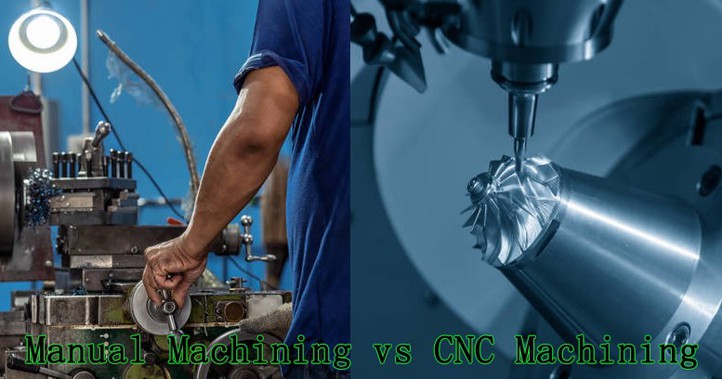
CNC machining and manual machining do the same job. They perform different cutting operations to give the part the desired shape and size. However, the methods they use or the quality they produce may be different. What differences are there between these two types of machining? This article will explore these differences. Let us move on.
Manual machining is the first form of machining. We cannot deny that highly skilled machinists did a great job manually in the heyday of manual machining. However, with the advent of computer technology, machining evolved into CNC machining. Today, CNC machining meets the needs of many advanced industries with its accurate, precise, and fast cutting process. On the other hand, manual machining is not completely lost. Some industries still keep benefiting from manual machining. Moreover, in some situations, it may be wise to opt for manual machining, rather than CNC machining. If you wonder why and wish to understand the differences between these two machining types, you can keep reading this article to find out the answer.
Manual Machining
Manual machining dominated the machining industry for a long time. It formed a deep-rooted machining culture and greatly contributed to the evolution of modern CNC machines and the development of the manufacturing industry. Although it has lost its popularity, they are still commonly used in the industry. Now let's take a closer look at manual machining.
Definition
The machine is controlled and operated by the machine operator. In other words, the cutting process is not automatic and the whole process is executed by human labor. For this reason, human error is more probable, many setups may be needed, and cutting operations take time. Conversely, expert machinists may also create artful workpieces, which may not be done by advanced CNC machines. With its advantages and disadvantages, manual machining continues to be used in the machining industry.
Machines
Manual Lathes
Using human labor, these machines can perform several cutting operations, such as drilling, knurling, reaming, or turning. The main parts of the machine are the collect chuck, tool post, tool holder, tailstock, and saddle. You can also control the machine using a compound slide hand wheel, cross slide hand wheel, cross slide hand lever, direction lever, feed direction knob, or spindle speed knob. You have to manually set up and adjust rotation speed, cutting depth, and feed speed to carry out the cutting operation and surface finish.
Manual Drill Presses
The main function of this machine is to create holes in the part. The workpiece is clamped on a table and the drilling bit, which is attached to the rotating spindle using a chuck, performs the drilling operation. Different drilling bits are used to obtain holes with different diameters and sizes. It is also possible to adjust the drilling speed.
Manual Milling Machines
You can still see these machines commonly in small workshops. They are operated by a machine operator and can perform a variety of cutting operations. That is why they are quite versatile and are appropriate for custom-cutting jobs. Especially, when they are adjusted and used by a skillful machinist, they can create fine details on the part.
Applications
Manual machining allows you to make changes on the part at any time from the setup until the final finish. Because the cutting process is directly controlled by the operator he/she may instantly decide that additions or subtractions should be made to the workpiece. This allows for flexibility in the production process and you can customize your product at any stage of the manufacturing. Eventually, manual machining is preferred when the customization of the product outweighs mass production.
On the other hand, especially small workshops are deprived of financial resources to invest in and maintain CNC machines. CNC machining may be too expensive for small jobs that do not require mass production and strict deadlines. At that time, it would be wise to opt for manual machining.
Another application of manual machining is quick and simple cutting jobs when we have no time to program the CNC machine. It would be a waste of time and money if we did these jobs using CNC machines. The machinist manually performs the cutting job and quickly delivers it.
Advantages and Disadvantages
| Advantages | Disadvantages |
| It needs a low initial investment. | It is too slow compared to CNC machining. |
| Its maintenance costs are also low. | It is not good for mass production. |
| It is good for one-off jobs. | Human errors are more probable. |
| It allows for customization. | It is not as accurate and precise as CNC machining. |
| It does not require programming skills. |
CNC Machining
The current trend in the machining industry is CNC machining. Now, let us peer into it in more detail.
A Revolution in the Machining Industry: CNC Machining
Before CNC machining, manufacturing heavily depended on human labor. Therefore, it was impossible to mass-produce products at high speeds. Along with this, human errors were inventible, and achieving tight tolerances was impossible. In the end, CNC machining came into our lives and revolutionized the manufacturing industry. Now, CNC machines easily produce intricate geometries and complex shapes at the request of any industry and can do it in a short time and on a large scale. That said, it is one of the wonders of the modern age.
Development Process of CNC Machining
The numerical controlling of machining was first found in a research project conducted at MIT. Later, Richard Kegg applied this technology to milling machines in 1952. At that time, there were no computers, and for that reason, punched tapes were used for numerical control. With the invention and widespread use of computers, computers replaced punched tapes and modern CNC machines arose.
Different Types of CNC Machines
CNC Milling Machines
These machines use multi-point cutters to perform different cutting operations. There are different mills to create different shapes and features. Many CNC milling machines have an ATC (Automatic Tool Changer) system. As a result, pre-programmed cutting operations are performed using different mills at different stages of the cutting process.
CNC Lathe Machines
Lathe machines use a turning tool and different cutters to perform the cutting operation. In this way, different operations such as finishing, facing, grooving, or threading are carried out. The whole cutting process is controlled by the computer.
CNC Drilling Machines
Drilling machines use drilling bits to create holes in the workpiece. Different bits are used for holes with different diameters and shapes and the drilling process is controlled by the computer.
Multi-Axis CNC Machines
In addition to linear axes, CNC machining uses rotary axes to approach the part from different angles and produce more intricate geometries. Today, we have CNC machines up to 7-axis and these machines are used in the most advanced industries.
Parts of CNC Machines
Control Panel
Using different buttons, you can program the cutting operation and control the machine.
Headstock
It ensures the stable motion of the part along with different axes by holding it.
Tailstock
The tailstock is positioned opposite the headstock and gives extra support to the workpiece.
Chuck
It is for clamping the workpiece. It grips the workpiece and keeps it at the center of the motion.
Spindle
It supplies rotational motion to the cutting tool, so it can perform the desired cutting operation.
Bed
It is the supporting point of the CNC machine. It houses the components of the machine and ensures its stability.
How Does A CNC Machine Work?
To operate a CNC machine, we first design a CAD model using CAD software. This model portrays the final product we wish to create.
Then, we must transform this model into a CNC file, which is also called G code. This is the coordinates of the desired cutting operation. We use CAM software to do this.
Next, we must configure our CNC machine. We must properly position the workpiece, complete the setup process, and adjust the settings.
Finally, our CNC machine is ready to operate. You can monitor and control the execution of the cutting operation from the control panel.
CNC Machining Operations and Applications
The main operations of a CNC machine are milling, drilling, routing, and grinding. You can also perform other operations such as broaching, facing, chamfering, knurling, honing, sawing, or lapping.
CNC machines can perform the cutting operation on a wide variety of materials such as metals (cast iron, aluminum, titanium, etc.), alloys (steel or brass), plastic (e.g. nylon), and wood.
CNC machining is used by many industries, including aerospace, automotive, medicine, and electronics, to produce auto parts, molds, casting models, prototypes, engravings, or frames.
Advantages and Disadvantages of CNC Machining
| Advantages | Disadvantages |
| It is good for mass production. It extremely increases accuracy and precision. It eliminates human errors. It decreases labor costs. There will be fewer breakdowns, so maintenance costs will be reduced. You can easily create intricate geometries and complex shapes. It increases repeatability. The cutting process is safer. The cutting process is automated. Once you complete the setup, the process is executed automatically. The system adjusts itself to prevent breakdowns. It also provides diagnoses against possible breakdowns. |
The initial investment is high. Especially for very complex jobs, skillful programmers are needed. Although breakdowns are rare, if they happen, fixing them may be expensive. They may not be appropriate for small and one-off jobs. |
A Comparison of CNC Machining and Manual Machining
| CNC Machining | Manual Machining | |
| Precision and Accuracy | The automated process allows for high precision and accuracy | Precision and accuracy fully depend on the operator's skills and the cutting process cannot be free from human errors. |
| Efficiency and Productivity | Production volume is high and cycle time is fast. | Production volume is low and cycle time is slow. |
| Complexity | It can produce very intricate geometries and complex contours. | Complexity depends on the operator's skills and it takes time to create complex shapes. |
| Versatility | As the cutting process is pre-programmed, it is extremely hard to make additions and subtractions to the part during the operation process. | Extremely versatile. You can make additions and subtractions at any stage of the operation process. |
| Skills and Training | Programming skills are needed. Academic training is required. | The operator's machining skills are crucial for the successful operation of the machine. Operators are trained as apprentices at workshops. |
| Initial Investment | High cost | Low cost |
| Long-Term Costs | Breakdowns are rare but costly. Needs energy | Breakdowns are more frequent and need skillful human labor and time, which can become costly. |
| Labor Costs | You need less labor but pay higher wages. | You need more labor but pay lower wages. |
| Human Errors | No human errors | Human errors are probable. |
If we summarize the table above, CNC machining is superior to manual machining in terms of accuracy and precision, efficiency productivity, and complexity. They are also free from human errors. On the other hand, manual machining is more versatile. You can change the design of the part at any time during the operation process. Finally, CNC machining is generally more expensive than manual machining in terms of initial investment, long-term costs, and training.
Which One Should You Choose?
In summary, CNC machining is more appropriate for high-volume production that needs high tolerances. On the contrary, you can opt for manual machining if your production volume is low and you produce customized products.
Our Machines
We specialize in the production of CNC machines. Our products include multi-axis CNC machines, vertical machining centers, horizontal machining centers, gantry machining centers, CNC drilling machines, and CNC boring machines. You can invest in our machines if you wish to scale up your business by increasing your production volume.
Conclusion
Manual machining is still widely used in the machining industry. However, we must note that CNC machining is the current trend. Especially, if you wish to expand your business and become a global manufacturer, you must invest in CNC machining. This article explored the differences between these two machining types and you will decide which one to choose.