




Machining large workpieces requires more than a large working table. Heavy loads, long machining cycles, and tight tolerances can make choosing the right CNC machine challenging.
So, how do you choose a gantry machining center that fits your workpieces without paying for unnecessary features?
This guide covers the main types of gantry machining centers, key specifications, and suitable applications. You'll also learn how to compare machine configurations and choose the right solution for your machining needs.
Why Choose a Gantry Machining Center for Large Workpieces?
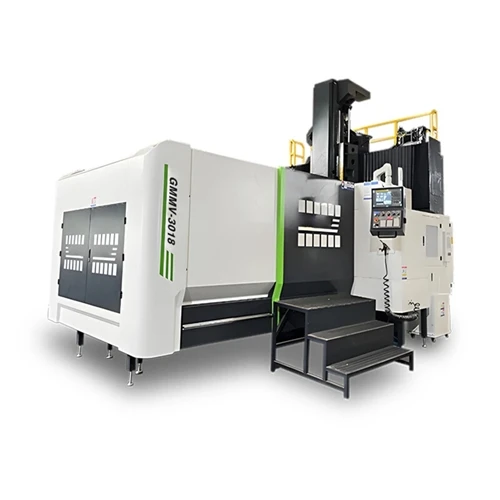
Large workpieces often require more machining space, higher load capacity, and better cutting stability than standard vertical machining centers can provide. A gantry machining center uses a double-column structure to support large-scale machining while maintaining rigidity and accuracy.
Here are four key advantages:
- Large Working Area: Provides extended X/Y/Z travel for machining large molds, machine beds, and structural components.
- High Load Capacity: Supports heavy workpieces, reducing the need to divide large parts into smaller sections for machining.
- Strong Structural Rigidity: The double-column and crossbeam structure helps reduce vibration and maintain stable cutting performance.
- Versatile Machining Capabilities: Supports milling, drilling, boring, and tapping. Optional angle heads or 5-axis configurations can also enable multi-side machining.
For manufacturers handling large, heavy, or complex workpieces, a gantry machining center can improve machining flexibility and reduce repeated setups.
Types of Gantry Machining Centers Explained
Gantry machining centers come in different structures and configurations. Each is designed for specific workpiece sizes, weights, and machining tasks. Understanding these differences helps you choose the right machine without paying for unnecessary features.
1. Fixed-Beam Gantry Machining Center
A fixed-beam gantry machining center has a rigid crossbeam supported by two columns, while the worktable moves along the longitudinal axis.
This design is commonly used for large molds, machine components, and heavy-duty milling applications.
- Best For: Large molds, machine bases, and general large-part machining.
- Key Advantages: Rigid structure, stable cutting performance, and flexible spindle configurations.
- Considerations: Requires sufficient floor space for worktable movement and adequate table load capacity.
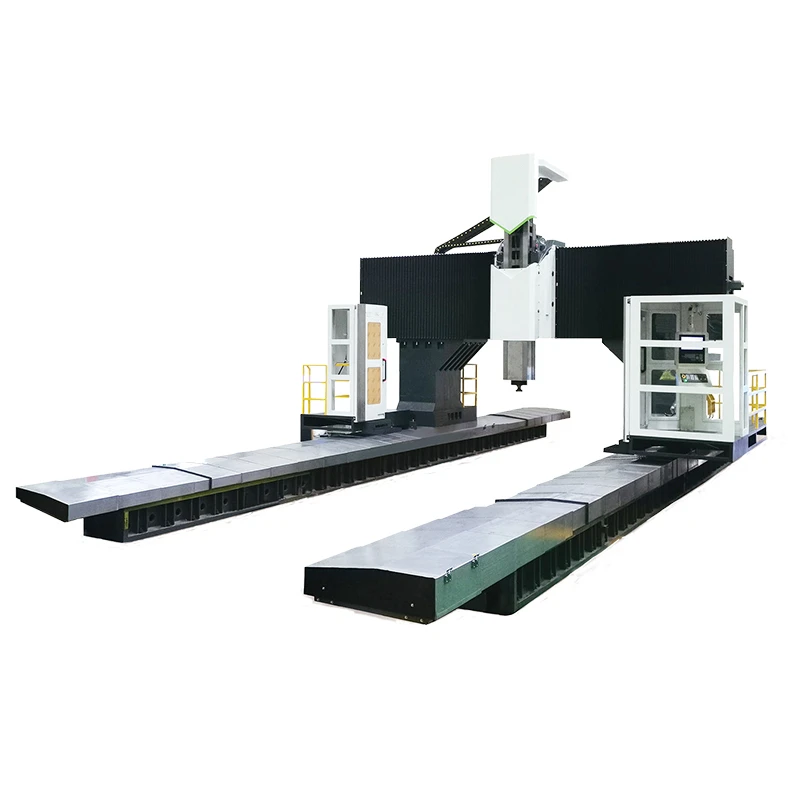
2. Moving-Column Gantry Machining Center
A moving-column gantry machining center moves its gantry structure along the machine bed while the worktable remains stationary.
This design is particularly useful for long, heavy workpieces that are difficult to move during machining.
- Best For: Long structural components, heavy machine frames, and large industrial parts.
- Key Advantages: Stationary workpiece support, easier handling of heavy loads, and extended machining travel.
- Considerations: Requires adequate floor space for gantry movement and a stable machine foundation.
3. 5-Axis Gantry Machining Center
A 5-axis gantry machining center adds rotary-axis capabilities to machine complex surfaces and features from different angles. Depending on the machine design, this may involve a 5-axis milling head or other rotary-axis configurations.
It is often used for aerospace components, complex molds, and parts requiring multi-angle machining.
- Best For: Complex curved surfaces, large precision molds, and multi-side machining.
- Key Advantages: Better tool accessibility, fewer setups, and improved flexibility for complex geometries.
- Considerations: Higher investment costs, more complex programming, and greater operator skill requirements.
Which Type Should You Choose?
For general large-part machining, a fixed-beam gantry is often a practical choice. If your workpieces are extremely heavy or long, consider a moving-column design. For complex surfaces that require machining from multiple angles, a 5-axis configuration may be more suitable.
Keep in mind that 5-axis is a machining configuration, not a separate gantry structure. Both fixed-beam and moving-column machines may offer multi-axis options, depending on the model.
Key Factors to Consider When Choosing a Gantry Machining Center
Choosing the right gantry machining center involves more than comparing machine sizes and prices. You need to evaluate its working range, load capacity, spindle performance, and accuracy based on your actual machining needs.
1. Workpiece Size and Machine Travel
Start with your largest workpiece dimensions. The machine must provide enough space for the workpiece, fixtures, and cutting tools.
- X/Y/Z Travel: Check whether the machine can reach all required machining areas.
- Distance Between Columns: Ensure the workpiece can fit between the gantry columns.
- Spindle-to-Table Clearance: Allow enough space for tall workpieces, fixtures, and long cutting tools.
2. Worktable Size and Load Capacity
Large workpieces can place significant loads on the machine table. For extremely heavy workpieces, a moving-column gantry with a stationary worktable may be more suitable.
- Table Dimensions: Must provide enough space for secure workpiece clamping.
- Maximum Table Load: Should accommodate the combined weight of the workpiece and fixtures.
- Load Distribution: Check whether the table can safely support uneven or concentrated loads.
3. Spindle Power, Speed, and Torque
Different materials and machining operations require different spindle capabilities.
- High Torque: Important for heavy roughing of steel, cast iron, and large structural components.
- High Spindle Speed: Suitable for smaller cutting tools and fine surface finishing.
- Spindle Power: Must support the required cutting conditions without excessive load.
4. Machine Rigidity and Accuracy
Large workpieces often require long machining cycles. Machine stability is essential for maintaining consistent cutting performance and dimensional accuracy.
- Machine Structure: Evaluate the bed, columns, crossbeam, and ram design.
- Guideway System: Check its suitability for the expected cutting loads and machining speed.
- Accuracy Performance: Compare positioning accuracy, repeatability, and relevant geometric accuracy specifications.
- Thermal Stability: Consider how temperature changes may affect accuracy during extended machining.
5. CNC Control and Optional Milling Heads
The CNC controller and milling head configuration determine which machining operations the machine can perform efficiently.
- CNC Controller: Choose a control system that supports your programming needs and existing workshop setup.
- Right-Angle Milling Head: Allows machining of vertical surfaces and side features.
- Universal Milling Head: Provides additional machining angles for complex workpieces.
- 5-Axis Milling Head: Supports simultaneous multi-axis machining when the machine is properly configured.
If your workpieces require machining on multiple faces, evaluate whether an optional milling head can reduce setups before investing in a full 5-axis machine.
The best gantry machining center should match your workpiece dimensions, weight, material, and machining operations. Prioritize the specifications that directly affect your production needs rather than paying for features you may never use.
Match the Gantry Machining Center to Your Application
Different industries have different machining requirements. A gantry machining center suitable for large molds may not be the best choice for heavy machine frames or complex aerospace parts. Matching the machine to your application helps you improve productivity and avoid unnecessary costs.
|
Application |
Main Machining Requirements |
Recommended Configuration |
|
Large Mold and Die |
High rigidity, surface accuracy, and stable finishing |
Double-column gantry with a suitable high-speed spindle |
|
Machine Beds and Frames |
Heavy cutting, high load capacity, and large working area |
Heavy-duty gantry with a high-torque spindle |
|
Wind Energy Components |
Large dimensions, heavy loads, and long machining travel |
Moving-column gantry with extended travel |
|
Aerospace Structural Parts |
Complex surfaces, multi-angle machining, and precision |
5-axis gantry machining center |
|
Rail and Long Components |
Long workpieces, multiple machining positions, and stable support |
Moving-column gantry with extended X-axis travel |
How Should You Decide?
Start with your most common workpieces and machining operations. If you mainly machine heavy steel components, prioritize rigidity and cutting torque. For large precision molds, focus on machine accuracy and spindle performance. If your parts require machining from multiple angles, consider optional milling heads or a 5-axis configuration.
Recommended GreatCNC Gantry Machining Centers
GreatCNC offers a range of gantry machining centers for large molds, heavy machine components, and complex structural parts. Here are three models worth considering based on your workpiece size and machining requirements.
1. GMM-3023 Heavy Cutting CNC Gantry Machine
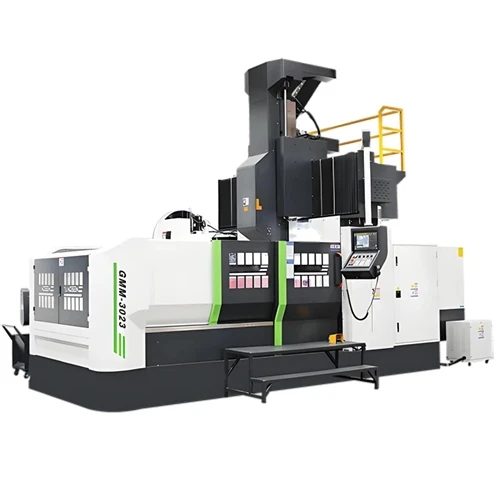
The GMM-3023 is built for heavy cutting on large molds, machine bases, and mechanical components. Its double-column structure provides stable support during demanding roughing and finishing operations.
- X/Y/Z Travel: 3,000 × 2,300 × 1,000 mm
- Maximum Table Load: 10 tons
- Spindle Speed: 6,000 rpm
- Key Advantage: Heavy-cutting capability with a 40-tool magazine and an optional 90° manual milling head.
Best For: Large mold machining and general heavy-duty milling.
2. GMM-8027 Large Gantry Milling Machine
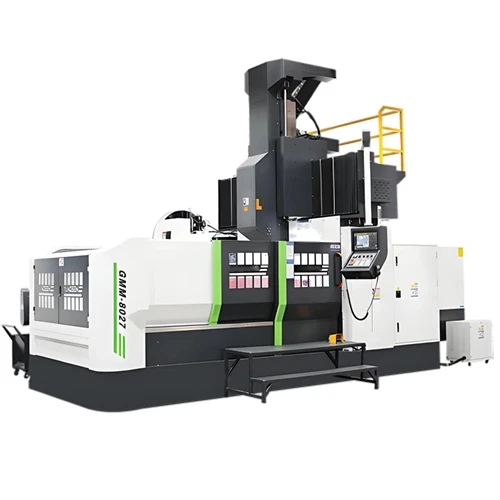
The GMM-8027 is designed for oversized workpieces that require extended machining travel. Its X/Y axes use heavy-load roller linear guideways, while the Z-axis uses a T-type ram box way for stable heavy cutting.
- X/Y/Z Travel: 8,000 × 2,700 × 1,250 mm
- Maximum Table Load: 25 tons
- Spindle Speed: 6,000 rpm
- Key Advantage: An 8-meter X-axis travel that handles long structural parts in fewer setups.
Best For: Long structural parts, large machine frames, and heavy industrial workpieces.
3. YSM-2820 High-Rigidity Double-Column Gantry Machine
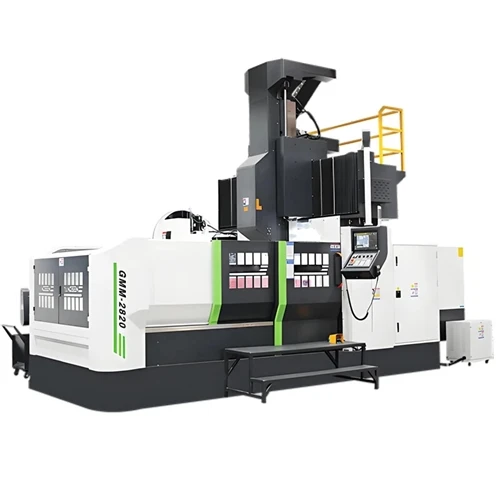
The YSM-2820 features a 10,000 rpm spindle, making it well suited to fine surface finishing on precision molds and components. It also supports an optional fourth-axis function for more flexible part handling.
- X/Y/Z Travel: 2,800 × 2,000 × 1,000 mm
- Maximum Table Load: 5 tons
- Spindle Speed: 10,000 rpm
- Key Advantage: High-speed spindle for fine finishing, with an optional fourth-axis function.
Best For: Precision molds and workpieces that require fine surface finishing.
Not sure which model fits your project? Share your workpiece drawings, dimensions, material, and machining requirements with GreatCNC. Our team can help you compare suitable gantry machining centers and choose a configuration that meets your production needs.
FAQs
1. What is the difference between a gantry machining center and a VMC?
+
-
The main differences are machine structure, working area, and load capacity. A gantry machining center uses a double-column structure and is generally better suited for large, heavy workpieces. A vertical machining center (VMC) is usually more compact and suitable for small to medium-sized parts.
2. Which gantry machining center is best for heavy workpieces?
+
-
A heavy-duty gantry machining center with a high load capacity and rigid structure is generally the best choice. For extremely heavy or long workpieces, a moving-column gantry with a stationary worktable may be more suitable. Always check the machine's load capacity, working range, and foundation requirements.
3. Can a gantry machining center perform 5-axis machining?
+
-
Yes, some gantry machining centers support 5-axis machining through additional rotary axes or specialized milling heads. This allows you to machine complex surfaces and features from different angles, reducing repeated setups. However, not every gantry machine supports simultaneous 5-axis machining, so check the specific configuration.
4. How much space does a gantry machining center need?
+
-
The required space depends on the machine's size, structure, and travel range. Besides its overall dimensions, you need to allow room for moving components, maintenance access, chip removal, and workpiece loading. Check the manufacturer's installation drawings and your factory's ceiling height, crane capacity, and foundation conditions.
5. What information do I need to choose a gantry machining center?
+
-
Start with your workpiece drawings, maximum dimensions, weight, material, and machining requirements. You should also provide the required tolerances, machining operations, preferred CNC controller, and available factory space. With this information, GreatCNC can help you compare suitable machine models and configurations for your project.
Conclusion
Choosing the right gantry machining center starts with understanding your workpiece size, weight, material, and machining requirements. By comparing machine structures, key specifications, and available configurations, you can find a machine that balances accuracy, productivity, and cost.
Looking for a gantry machining center for your large workpieces? GreatCNC offers a range of gantry machining centers for different industrial applications. Contact our team with your workpiece drawings and machining requirements to explore suitable machine models and get a customized quotation.
