



CNC lathes are widely used to machine shafts, bushings, flanges, and other rotational parts. Machine structure, spindle performance, and tooling configuration all affect what you can machine, how accurately, and how efficiently.
So, what is a CNC lathe, and what makes it suitable for different machining tasks?
This guide explains how CNC lathes work, the main types available, and the operations they can perform. You'll also learn what affects machining performance and how to determine whether a CNC lathe fits your production needs.
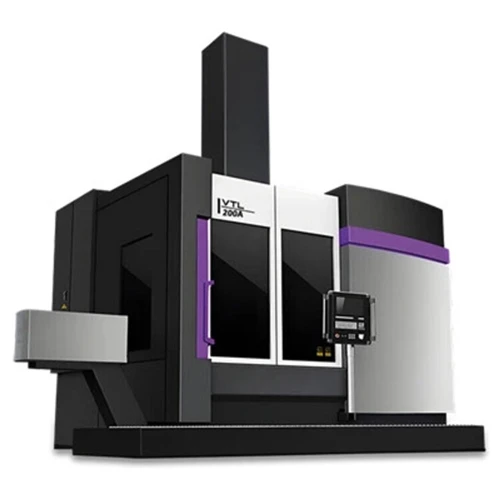
What Is a CNC Lathe?
A CNC lathe is a computer-controlled machine tool that rotates a workpiece while cutting tools remove material to create precise cylindrical parts. It is commonly used for turning, facing, boring, grooving, and threading operations.
Unlike manual lathes, CNC lathes use programmed instructions to control tool movements, spindle speed, and feed rates. This allows them to produce complex profiles with consistent accuracy and repeatability.
Depending on the machine configuration, a CNC lathe can also perform drilling, milling, and other operations, reducing the need for multiple setups.
How Does a CNC Lathe Work?
A CNC lathe works by rotating the workpiece while a cutting tool moves along programmed paths to remove material. Unlike a CNC milling machine, where the cutting tool typically rotates, a lathe uses the rotating workpiece as its primary cutting motion.
The machining process generally follows five steps:
- Workpiece Clamping: The workpiece is secured in a chuck or held between centers to maintain stability during machining.
- Program Execution: The CNC controller reads the machining program and controls spindle speed, tool movements, and feed rates.
- Spindle Rotation: The spindle rotates the workpiece at a programmed speed based on its material, diameter, and cutting requirements.
- Material Removal: Cutting tools move along the programmed paths to perform turning, facing, boring, or other operations.
- Part Inspection: The finished part is checked for dimensional accuracy and surface finish.
How Do CNC Lathe Axes Work?
Most standard CNC lathes use two primary axes:
- X-Axis: Controls the tool's radial position, determining the cutting depth and workpiece diameter.
- Z-Axis: Moves the tool parallel to the spindle, controlling the cutting length and axial position.
More advanced CNC lathes may include a C-axis for precise spindle positioning and a Y-axis for off-center machining. When combined with live tooling, these additional axes allow the machine to perform drilling, milling, and other operations without moving the workpiece to another machine.
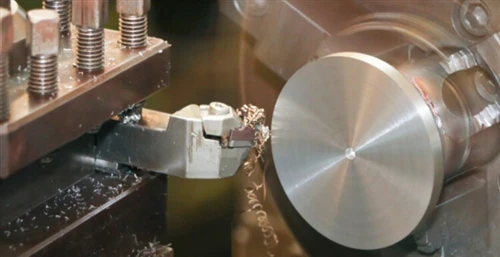
Main Components of a CNC Lathe
A CNC lathe consists of several key components that work together to control cutting movements, support the workpiece, and maintain machining accuracy.
|
Component |
Main Function |
Why It Matters |
|
Spindle |
Rotates the workpiece at controlled speeds. |
Spindle speed, torque, and stability affect cutting performance. |
|
Chuck |
Clamps and holds the workpiece during machining. |
Proper clamping reduces vibration and prevents workpiece movement. |
|
Tool Turret |
Holds multiple cutting tools and indexes them into position. |
Reduces tool-changing time and supports multiple operations in one setup. |
|
Machine Bed |
Provides a rigid foundation for the machine's moving components. |
High rigidity helps reduce vibration and maintain machining accuracy. |
|
Tailstock |
Supports the free end of long workpieces. |
Helps prevent deflection when machining long shafts. |
|
Guideways & Ball Screws |
Guide and drive precise tool movements along the machine axes. |
Influence positioning accuracy, repeatability, and motion stability. |
|
CNC Controller |
Executes machining programs and coordinates machine movements. |
Controls tool paths, spindle speed, feed rates, and machining sequences. |
|
Coolant System |
Delivers cutting fluid to the machining area. |
Helps control cutting temperatures, improve chip removal, and extend tool life. |
What Operations Can a CNC Lathe Perform?
A CNC lathe can perform several machining operations in a single setup, from basic turning to complex threading and internal machining. The available operations depend on the machine's axis configuration, tooling, and workholding system.
Common CNC Turning Operations
Most CNC lathes can perform the following operations using standard cutting tools:
- External Turning: Removes material from the outside diameter to produce cylindrical or tapered surfaces. Typical applications include shafts, pins, and sleeves.
- Facing: Cuts across the end of a rotating workpiece to create a flat surface. Typical applications include flanges, discs, and shaft ends.
- Boring: Enlarges or finishes an existing hole to achieve the required diameter and surface finish. Typical applications include bushings and bearing housings.
- Threading: Cuts internal or external threads with controlled pitch and depth. Typical applications include threaded shafts and pipe fittings.
- Grooving: Creates narrow grooves on external or internal surfaces. Typical applications include seal grooves and retaining ring grooves.
- Parting: Cuts through the workpiece to separate the finished component from the remaining stock. Typical applications include pins, bushings, and small turned parts.
- Drilling: Produces axial holes using a drill mounted in the turret or tailstock. Typical applications include shafts, sleeves, and fittings.
Additional Operations with Live Tooling
CNC turning centers equipped with live tooling and suitable axis configurations can perform operations beyond conventional turning:
- Milling: Machines flats, slots, and other features using rotating cutting tools.
- Off-Center Drilling: Produces holes away from the workpiece centerline with suitable C-axis and Y-axis capabilities.
- Tapping: Creates internal threads using driven tools and synchronized machine movements.
- Complex Contouring: Machines features that require coordinated movement of multiple axes.
These capabilities allow manufacturers to complete more operations without transferring parts between machines. This can reduce setup time, improve feature-to-feature accuracy, and increase production efficiency.
What Parts Can Be Made on a CNC Lathe?
CNC lathes are mainly used to produce cylindrical, round, and other rotational parts. They can machine components ranging from small precision pins to large industrial flanges, depending on the machine's size, structure, and cutting capacity.
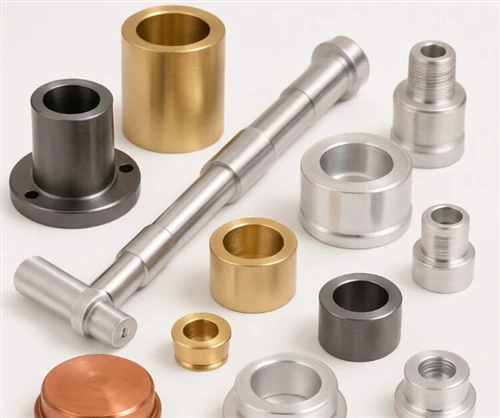
Typical CNC lathe parts by industry include:
- Automotive: Transmission shafts, brake discs, wheel hubs, and bushings, which require consistent dimensions, tight tolerances, and efficient batch production.
- Aerospace: Precision shafts, bushings, fittings, and landing gear components, which demand high accuracy, reliable surface finish, and the ability to machine difficult materials.
- Oil & Gas: Valve bodies, pipe fittings, and threaded connectors, which require strong cutting performance, accurate threading, and stable heavy-duty machining.
- Machinery Manufacturing: Spindles, bearing housings, sleeves, and pulleys, which require accurate diameters, concentricity, and consistent surface quality.
- Railway: Railway wheels, axles, and bearing components, which need large workpiece capacity, high rigidity, and stable machining under heavy cutting loads.
- Medical Equipment: Surgical instrument components, orthopedic screws, and precision fittings, which require small-part accuracy, fine surface finishes, and consistent repeatability.
For example, a horizontal CNC lathe is commonly used for shafts, sleeves, and other parts where the length is greater than the diameter. A vertical CNC lathe is often better suited for large, heavy components such as railway wheels, bearing rings, and flanges.
For parts requiring both turning and milling features, a CNC turning center with live tooling can complete additional operations in a single setup, reducing the need for secondary machining.
What Determines CNC Lathe Machining Performance?
Two CNC lathes with similar specifications may deliver different results under the same cutting conditions. Machining accuracy, surface finish, and production efficiency depend on more than spindle speed or machine size. The following factors have the greatest impact on actual machining performance.
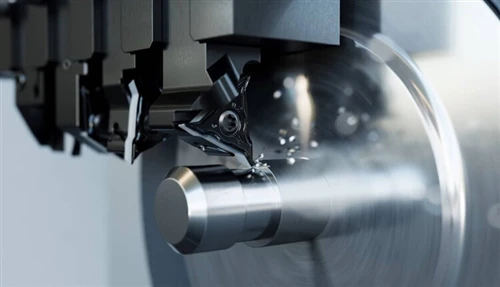
Spindle Speed and Torque
Spindle performance determines how well a CNC lathe handles different materials and cutting conditions.
High spindle speeds are useful for machining smaller parts and achieving suitable cutting speeds. High torque at lower speeds is important when turning large-diameter workpieces or performing heavy cuts.
For example, rough turning a large steel shaft requires sufficient torque to maintain stable cutting, while finishing a small aluminum component may benefit from higher spindle speeds.
Machine Rigidity
Machine rigidity directly affects cutting stability, especially during heavy roughing and interrupted cuts.
A rigid machine bed, stable guideways, and well-supported spindle help reduce vibration and tool deflection. Poor rigidity can cause chatter marks, uneven surface finishes, and faster tool wear.
This becomes particularly important when machining hard materials, long shafts, or large workpieces that generate high cutting forces.
Positioning Accuracy and Repeatability
Positioning accuracy determines how closely the cutting tool reaches its programmed position, while repeatability measures how consistently it returns to the same position.
Both are important for maintaining dimensional tolerances, especially in batch production. However, actual part accuracy also depends on thermal stability, tool wear, workholding, and cutting conditions.
Workholding and Tooling
Even a high-precision CNC lathe cannot deliver stable results if the workpiece is poorly clamped or the cutting tools are unsuitable.
Chuck type, clamping force, tool geometry, and tool overhang all influence machining stability. Long shafts may require tailstock or steady-rest support, while thin-walled components need careful clamping to prevent deformation.
Matching the workholding and tooling to the part helps improve surface finish, dimensional consistency, and tool life.
Automation and Production Efficiency
For high-volume production, machining performance also depends on how efficiently the machine handles loading, unloading, and tool changes.
Features such as bar feeders, automatic parts catchers, robotic loading systems, and tool monitoring can reduce manual intervention and non-cutting time.
However, automation does not automatically improve cutting accuracy. Its main value is increasing machine utilization and maintaining a more consistent production cycle.
FAQs
1. What Is the Difference Between a CNC Lathe and a CNC Turning Center?
+
-
A CNC turning center typically offers more machining capabilities than a basic CNC lathe. While standard CNC lathes focus on turning operations, turning centers may include live tooling, C-axis control, Y-axis movement, and sub-spindles for additional operations.
2. How Many Axes Does a CNC Lathe Have?
+
-
Most standard CNC lathes have two axes: X and Z. The X-axis controls radial tool movement, while the Z-axis controls movement along the spindle. Advanced CNC turning centers may include C-axis, Y-axis, or additional configurations for more complex machining operations.
3. What Materials Can a CNC Lathe Machine?
+
-
CNC lathes can machine a wide range of materials, including carbon steel, stainless steel, aluminum, brass, cast iron, and titanium. They can also process certain engineering plastics. The machine's rigidity, spindle performance, cutting tools, and coolant system determine how effectively it handles different materials.
4. Can a CNC Lathe Perform Milling Operations?
+
-
Yes, a CNC lathe equipped with live tooling and suitable axis controls can perform milling operations. These machines can produce flats, slots, and other features without transferring the workpiece to a separate milling machine. Standard CNC lathes without live tooling cannot perform conventional milling operations.
5. What Is the Difference Between Horizontal and Vertical CNC Lathes?
+
-
The main difference is spindle orientation and workpiece support. Horizontal CNC lathes are commonly used for shafts, sleeves, and other cylindrical components. Vertical CNC lathes hold the workpiece on a vertical-axis rotating table, making them particularly suitable for large, heavy parts such as flanges, bearing rings, and railway wheels.
Conclusion
A CNC lathe is a versatile machine for producing cylindrical and rotational parts with consistent accuracy and efficiency. Whether you're machining small precision components or large industrial parts, matching the CNC lathe to your application is key to reliable production.
Looking for the right CNC lathe? GreatCNC can help you compare suitable machine models and configurations based on your workpiece size, material, and production needs. Contact us to discuss your machining requirements and find a suitable solution.
