


CNC machining is based on the use of cutting tools, which are the end mills and drills that will create high-accuracy and precision parts of complex geometries by using a raw material. To have effective CNC machining, provide high-quality parts, and eliminate waste, it is be to understand the different features, types, and applications for end mills and drills. End mills and drills have different roles in CNC machining, but they also work together by removing material. They also provide their unique features and are only used for certain forms of cutting. An end mill often performs multiple functions, such as slotting, profiling, and contouring, whereas a drill removes material when cutting holes, where the cylindrical hole is the final objective. Knowing how an end mill and a drill differ, as well as knowing when to use a different cutting tool, will assist in the efficiency, tool life, and quality.
Some companies have some important contributions to make to the machinists in achieving these goals, with a full selection of end mills, drills, and CNC machines with an array of applications. Each of their tools, products, and equipment is made with precision, durability, and modern machining practices to give the technician the optimal performance on all CNC project outcomes.
This article will explore the differences between end mills and drills, best practices, and key insights regarding advances in 2025. Few companies will provide you with the necessary tools and resources that will take you to the next level as a machinist, whether you are a professional machinist in a factory or a hobbyist machinist in your garage.
Understanding End Mills in CNC Machining
What is an End Mill?
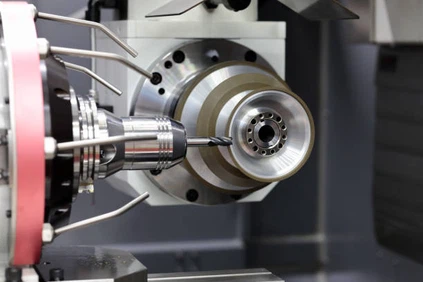
An end mill is a type of cutting tool utilized in industrial metalworking and CNC machining, primarily in milling machines. While drill bits cut only in the axial direction. The end mill can cut in all directions (axial and lateral). An end mill has very usable cutting edges on both the tip and the sides, allowing it to create complex shapes, slots, contours, and profiles in many materials, including metal, plastic, and wood. End mills come in a variety of shapes and sizes, including flat, ball-nose, or corner-radius, for a variety of tooling operations.
Types of End Mills
End mills are produced in numerous variations, each designed for its applications. The following are the more common types of end mills:
Square End Mills: Perfect for creating flat-bottom cuts, vertical walls, and just about anything where milling is required. They are frequently the end mill type for general-purpose milling, and one of the commonly used and popular end mills. They are mostly used for aluminum and steel.
Ball Nose End Mills: Because of the round tip (ball-like section), the ball end mill is used for 3D contouring and is often used to make molds and produce a smooth surface finish.
Corner-Radius End Mills: Durability, has a round corner, and reduces stress and wear in high-strength materials.
Roughing End Mills: Depending on the manufacturer, they usually have serrated flutes intended to help with rapid material removal and are useful for hogging out/or processing with large volumes.
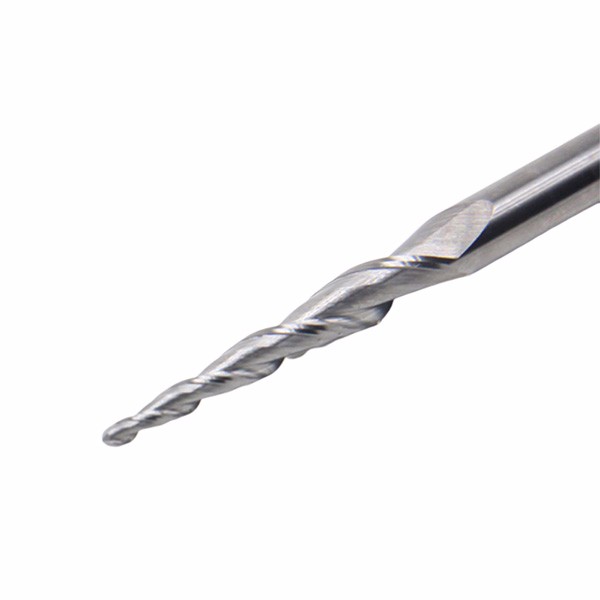
Tapered End Mills: If you need to create angled slots, molds, or dies, tapered end mills have strength designed for deep cut structures.
|
Type |
Applications |
Materials |
Flute Count |
Benefits |
|
Square End |
Flat-bottom cuts, vertical walls |
Steel, aluminum |
2–4 |
Versatile, precise edges |
|
Ball Nose |
3D contouring, mold making |
Plastics, soft metals |
2–4 |
Smooth curves, fine finishes |
|
Corner-Radius |
High-strength material milling |
Stainless steel, titanium |
4–6 |
Durable, reduces corner stress |
|
Roughing |
Rapid material removal |
Aluminum, steel |
3–5 |
Fast stock removal, reduced heat |
|
Tapered |
Angled slots, molds |
Hardened steel |
2–4 |
Strong for deep, angled cuts |
Have a great selection of end mills, both carbide and coated, designed to work harmoniously with their high-performance CNC mills.
Materials and Coatings for End
MillsEnd mills are usually made from high-speed steel (HSS), carbide, and cobalt. Carbide is the hardest material and holds up for higher heat resistance for machining tough materials like titanium, which is why it is utilized. HSS is the cheapest and works for softer materials. Cobalt is a combination, good for both the price and durability. Only about 25% of end mill efficiency relates to the cutting tool and the very best coating for the application.
The other 75% of end mill efficiency relates to the cut parameters, including speed, advance per tooth, depth of cut versus tool diameter, chip loads, and optimized cutting profiles. Coatings for end mills are titanium nitride (TiN), titanium aluminum nitride (TiAlN), and aluminum titanium nitride (AlTiN).
The coatings reduce friction between the cutting tool and the bulky requirement, and the coating also reduces heat in the cutting tool. For example, TiAlN provides excellent high-temperature condition machining (stainless), and TiN is recommended for aluminum.
The choice of recommended tool material and coating is primarily based on the material of the workpiece, the cutting speed being used, and the length of time you want the cutting tool to life.
With more knowledge of the materials and coatings of end mills, it will give you specs to guide the machinist or hobbyist to get the recommended end mill for their particular. You can't know how much work can be completed without understanding the association between drills in CNC machining.
What is a Drill Bit?
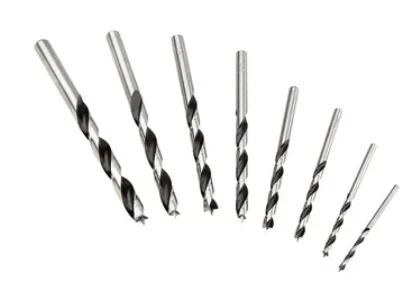
A drill is a specialized cutting tool used in CNC machining to create cylindrical holes through axial cutting. Unlike end mills, which can cut laterally, drills are designed to penetrate the material to create a through or blind hole (i.e., not cut laterally, or they would be end mills). The drill consists of some key features: a point angle that is typically 118 degrees for most drilling applications and 135 degrees for harder material; helical flutes for the evacuation of chips; and a shank that the machinist or operator will secure the drill in the machine. Drills, more often than not, are the most important tool in assemblies and are used to determine the location of holes for bolt patterns, and they need to be stable, consistent, and accurate, so they will be critical to both simple and complex CNC projects.
Types of Drill Bit
Twist Drills: These are the standard drills for general hole making in metals, plastics, and wood.
Center Drills: Center drills create small pilots for other drill bits to follow and ensure the other drill gets drilled accurately.

Spotting Drills: Spotting drills create start points to avoid drill walking.
Reamers: Reamers are for boring holes that must be finished to tight tolerances and create a smoother surface.
Ejector Drills: Ejector drills are a designed drill that removes chips efficiently after drilling deep holes.
|
Type |
Applications |
Materials |
Point Angle |
Benefits |
|
Twist Drill |
General-purpose hole-making |
Steel, aluminum, wood |
118°–135° |
Versatile, widely available |
|
Center Drill |
Pilot holes, centering |
All metals |
60°–90° |
High precision prevents drill walking |
|
Spotting Drill |
Hole starting points |
Hard metals |
90°–120° |
Accurate positioning |
|
Reamer |
Hole finishing, tight tolerances |
Steel, alloys |
N/A |
Smooth, precise hole surfaces |
|
Ejector Drill |
Deep hole drilling |
Hardened materials |
135° |
Efficient chip evacuation, deep reach |
They have a large selection of drill bits, including high-performance carbide drills, and they sell drilling machines that use CNC technology for precise hole-making, as well as using drills in the drilling machine.
Drill Geometry and Performance
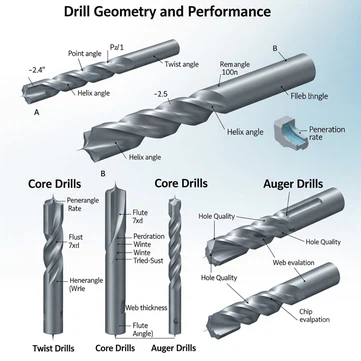
Drill performance depends greatly on geometry and drill bit design. Some of the factors that affect geometry are point angle, flute shape, and helix angle. The most common drill point angles are 118° for softer materials and 135° for harder alloys. Flute design affects drill chip evacuation. Flute design on drill bits is generally classified into two types: Low-helix and high-helix. The higher helix flutes are useful for cutting soft materials like aluminum, while low-helix flutes offer good strength for harder materials. In addition to flute design, helix angle will also affect potential tool life and cutting efficiency. Low-helix bits are very useful for materials that tend to be more difficult to penetrate.
High helix bits are used for less rigid materials that require considerable chip flow. Drill type may also depend on the depth of the hole and the material. For deeper holes, you will generally require specialty end-drill designs, such as ejector drills, which require different chip evacuation. Whereas, for shallow holes, standard twist drill bits may be appropriate. As you evaluate the options of drill-around depth of hole and material type, some companies provide functionality to help you decide on drill selection.
End Mill vs Drill Bit: What is the difference and how do they function in practice

Functional Differences
End mills and drills serve distinct machining purposes. An end mill has multi-function capabilities for lateral cutting, radiused plunges, slotting, and profiling functions, and can achieve complicated geometries. By contrast, drills are functional only in the axial cutting direction to produce cylindrical holes. Drills are precision tools, but they have a diminished machining/functional range.
|
Feature |
End Mill |
Drill Bit |
Best Use Case |
|
Cutting Direction |
Lateral and axial |
Axial only |
End mill: contours; Drill: holes |
|
Applications |
Slotting, profiling, pocketing |
Hole-making |
End mill: 3D shapes; Drill: bolts |
|
Versatility |
High |
Low |
End mill: multi-task; Drill: specific |
|
Tool Geometry |
Flutes, cutting edges on the side/tip |
Point angle, flutes for chip removal |
End mill: complex; Drill: simple |
Application Scenarios
There are many applications for end mills, including pocketing, contouring, slotting, and 3D machining, like making molds or curved surfaces. Drills are more applicable in circumstances where you want precision hole making, either through holes (for bolts) or blind holes (for dowels). Drills serve a different purpose than end mills, but hybrid tools such as drill/end mills combine features of both for jobs that require both operational drilling and milling.
Tool Selection
After determining where to cut, the next part of selecting a tool is to consider the material (aluminum or titanium), depth, accuracy, and finish of the part. You will also want to consider the machine's capability, defined by spindle power or speed, when defining tool specifications. Offers an online catalog of typical tool specifications for specific CNC projects, both in and out of the shop, used to find the right tool the first time and ensure the optimal intended performance based on the project settings.
Best Practices of Using End Mills and Drill Bits
Tool Selection and Setup
Take geometry into account (high-helix end mills for aluminium versus low-helix drills for steel). However, do not push the integration of tooling into the spindle beyond the natural machine shells unless you're using collets, a chuck, or a precision tool holder. Resist the urge to over-tighten to reduce machine vibration. The manufacturer's recommendations for spindle speed and feed rate should be followed to ensure the efficiency and longevity of your tool.
To optimize tool performance, if muscle memory allows, consider high-pressure coolant when machining titanium or stainless steel, primarily to reduce operational heat and tool life. We still want to use an adequate flute design as an example of some sort of through-hole. You may need multiple flute designs for the drill bit versus the end mill, as well as different types of peck drilling for deep holes. We want to ensure we have proper sustainability for chip removal. Don't forget to adhere to the recommended depth of cut and feeding rate to avoid tool deflection.
|
Material |
Tool Type |
Spindle Speed (RPM) |
Feed Rate (IPM) |
|
Aluminum |
End Mill |
10,000–15,000 |
50–100 |
|
Steel |
End Mill |
2,000–5,000 |
10–30 |
|
Aluminum |
Drill Bit |
8,000–12,000 |
20–50 |
|
Steel |
Drill Bit |
1,500–3,000 |
5–15 |
Maintenance and Lifespan of Tools
Properly store tooling and tooling systems in protective cases to prevent damage. Be sure to examine tooling for wear and even check for edge chipping, and sometimes the most effective possible move is to just re-sharpen the tool, which may also save money.
Tips for CNC Machinists
Don't break tools by using too much depth or speed when cutting.
Always choose tools according to their specified materials: carbide for harder metals and HSS for softer metals.
Make certain you have your workpiece clamped to minimize deformation or vibration of the workpiece, tool, and spindle.
Automatic tool changers eliminate the time to manually switch tools for multiple tool jobs.
There are software options for manufacturers and machinists to shape their practices for an integrated workflow.
How GreatCNC Helps You Choose the Right End Mills and Drill Bits
At GreatCNC, we make tool selection easy by giving you practical, engineering-level guidance based on your material, machine type, drawing tolerance, and production goals. You can share just three details: material hardness, hole depth, and required features-and our team will recommend the exact end mills or drill bits you need. Whether you're machining aluminum brackets, 40HRC mold steel, or high-volume stainless-steel parts, we help you balance tool life, surface finish, and cost. With ready stock, mixed-batch shipping, and high-performance carbide tools, GreatCNC gives you a fast, reliable, and cost-effective solution for any CNC job.
Conclusion
End mills and drills are equally important in CNC machining. Both have unique characteristics; end mills can be used for milling and a more versatile milling purposes, while drills can only drill holes. Choosing the right tool for the intended purpose, optimizing performance, and embracing innovations like AI toolpaths and new coatings in 2025 will give the operator the best opportunity for success. Some companies have tools, CNC machines, and maintenance equipment for any machinist wishing to work smart. Don't hesitate to look through the catalogue provided to step up your CNC projects while maintaining high standards.
FAQ
01. Can I use an end mill to drill holes in CNC machining?
02. Can a drill bit be used for milling operations?
03. Which tool gives a better surface finish, end mill or drill bit?
04. What is better for flat-bottom holes, an end mill or a drill bit?
05. How do I choose between an end mill and a drill bit for your CNC job?