


In the field of machining, choosing the right cutting tool is crucial to machining efficiency, surface quality, and cost control. Face milling cutters and end mills are the two most commonly used milling tools, but many machinists and purchasers are confused about the differences and application scenarios between them. This article will deeply compare the characteristics, advantages, limitations, and best application scenarios of these two tools to help you make an informed decision.
What Is a Face Milling Cutter?
A face mill is a cutting tool used primarily for surface machining, especially for producing a flat and smooth surface on large surfaces. Unlike end mills, which cut with the tip and side of the tool, face mills cut with inserts mounted on the surface or periphery of a rotating cutter body. These replaceable inserts cut as the cutter rotates across the workpiece surface.

Features of Face Milling Cutter
Here are some of the key unique features of face milling cutters:
Multiple Cutting Inserts
Face milling cutters are often equipped with multiple inserts (usually carbide inserts), which enable wider cutting paths and faster material removal rates.
Large Cutting Diameter
Face mills are available in a variety of diameters and are generally larger than end mills to help with large surface areas.
Indexable Inserts
Allow the inserts to be rotated or replaced as they wear, making face milling more cost-effective in the long run.
Cutter Body Material
The cutter body is usually made of durable steel or coated alloy to withstand the strong cutting forces during machining.
Cutting Edge Geometry
Most face milling cutters have a positive rake angle, which helps reduce cutting forces and improve surface finish.
Application of Face Milling Cutter
Face milling cutters are widely used in industrial machining operations that require strict flatness and surface finish. The following are some common applications:
Flat Surface: Ideal for squaring raw materials or achieving precise thickness on large sheets.
Finishing: When surface quality is critical (on a die or machine tool), a face milling cutter provides a smoother surface finish than a roughing cutter.
Large Volume Material Removal: In high volume production, face milling cutters can be used to quickly remove stock due to their wide cutting paths.
Automotive and Aerospace Parts: They are commonly used in machining engine blocks, cylinder heads, and structural components.
Advantages of Face Milling Cutters
High Material Removal Rate: Thanks to its large cutting area and multiple inserts.
Excellent Surface Finish: Especially when using positive inserts and fine pitch configurations.
Insert Economy: Inserts can be indexed or replaced individually, reducing downtime and tool costs.
Rigidity and Stability: The large cutter body provides a stable platform, minimizing vibration.
Disadvantages of Face Milling Cutters
Limited to Flat Surface Machining: Face mills are not suitable for deep cavities, small features, or complex contours.
Requires Larger Machines: Due to their size and weight, face milling cutters require high spindle power and high rigidity.
What Is an End Milling Cutter?
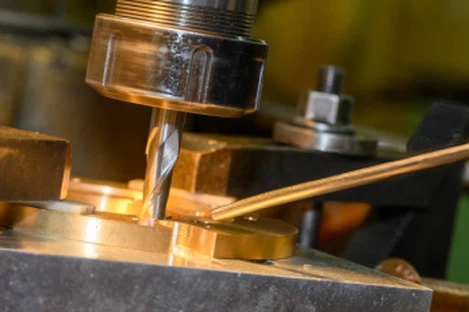
End milling cutters are one of the most commonly used cutting tools in CNC machining. Unlike face mills, which are mainly used for flat surface machining, end mills can cut in all directions- downward, sideways, and even at an angle. It is like the Swiss Army Knife of milling cutters, ideal for contouring, grooving, drilling, and finishing of complex shapes.
Features of End Milling Cutter
Cutting edges at the tip and sides: An end milling cutter can cut both axially (into the material) and radially (on the sides).
Various Blade Types
2-blade, 3-blade, 4-blade, etc. The fewer the blades, the better the chip removal effect; the more the blades, the smoother the surface.
Various Shapes
Including square, ball, and rounded heads.
Material Selection
Usually made of high-speed steel (HSS), carbide, or cobalt alloy to improve hardness and wear resistance.
Optional Coatings
Such materials as TiN, TiAlN, and AlTiN can reduce heat and extend tool life.
End Milling Cutter Applications
End milling cutters are versatile and can be used for a variety of operations, including:
Grooving and Pocketing: Ideal for cutting internal shapes and grooves.
Profiling and Contouring: Ideal for machining curves, 3D surfaces, and part contours.
Drilling and Plunging: Although end mills are not dedicated drills, some end mills can penetrate materials like a drill.
Finishing: Providing a fine surface finish, especially in mold making and die cutting.
Advantages of End Milling Cutter
High Precision: Very suitable for fine and complex processing work.
Versatility: One tool can perform multiple tasks, saving time and tool changes.
Directional Cutting: Ability to move in any direction, suitable for complex paths.
Disadvantages of End Milling Cutter
Slower Surface Coverage: End milling cutters remove less material in a single pass compared to face mills.
Excessive Tool Wear: This is especially common in cases of rough machining or improper use.
Limited Applications for Large Flat Surfaces: When you need to quickly flatten a wide surface, an end mill isn't the best choice.
Prone to Vibration: Especially when using long-distance tools or hard materials, vibration is likely to occur.
Face Milling Cutter vs. End Milling Cutter: Process
In mechanical processing, face milling cutters and end mills are two commonly used milling tools. Their structural processing technologies have different focuses and are suitable for different processing scenarios.
Face Milling Process
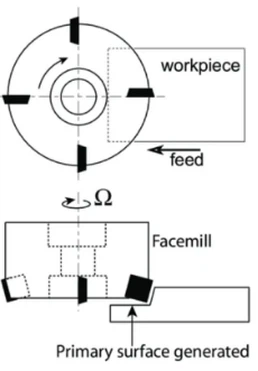
Face milling is a commonly used plane milling process. The multi-edge face milling cutter installed on the spindle of the milling machine rotates at high speed to cut the surface of the workpiece to achieve efficient and high-precision plane processing. This process is suitable for processing large workpiece surfaces or mass production, and has the characteristics of smooth cutting, high processing efficiency, and good surface quality. During operation, it is necessary to select the appropriate tool material (carbide or high-speed steel), cutting parameters (speed, feed rate, cutting depth) and cooling method (dry cutting or wet cutting) according to the hardness of the material, and ensure that the workpiece is clamped firmly to avoid vibration or deformation.
End Milling Process

End milling is a versatile milling process that uses the side and end edges of a cylindrical end mill to cut and can complete the processing of planes, steps, grooves, contours, and three-dimensional surfaces. End mills usually have 2 to 6 spiral cutting edges and are suitable for finishing or semi-finishing of materials such as steel, aluminum, and cast iron. During processing, it is necessary to select the appropriate tool diameter, edge length, helix angle, and coating (TiN, TiAlN) according to the workpiece material and processing requirements, and reasonably set the spindle speed, feed speed, and cutting depth to avoid tool vibration or chipping. For deep grooves or high-hardness materials, layered milling or high-speed milling (HSM) strategies can be adopted, combined with cutting fluid cooling and lubrication to improve tool life and surface quality.
Key Differences Between Face Milling Cutter and End Milling Cutter

Understanding the key differences between face mills and end mills is not just about understanding how they look, but also how they work during the machining process. Let's break it down step by step.
Cutting Direction
The main difference is the direction of cutting. A face mill is designed to cut horizontally on the top surface of a workpiece. It removes material from the face of the part, leaving a flat surface. In contrast, an end mill cuts vertically and radially, meaning it cuts straight into the material and along the sides. This makes end mills useful for machining cavities, slots, holes, and contours.
Tool Geometry and Construction
Design of the tool. Face milling cutters usually have a large, flat body with multiple indexable inserts mounted on the face. These inserts are replaceable and are well able to withstand heavy cutting loads. On the other hand, end mills are solid tools with spiral grooves on the sides and cutting edges on the tip. Their compact and sturdy design makes them better suited for fine machining. Geometry plays an important role in determining the best performance of each tool. If the cutter is too small, then an end mill is a better choice.
Structure and Design
Face mills are usually larger in diameter and have multiple replaceable inserts mounted on the face of the tool. These inserts carry most of the cutting load. End mills, on the other hand, are typically solid tools made of carbide or high-speed steel with spiral grooves running along the sides of the tool. This difference in construction affects how each tool dissipates heat, evacuates chips, and provides surface finish.
Check Machine Tool and Power Requirements
Because face mills are larger and remove more material per pass, they typically require higher horsepower and more rigid machines, such as vertical or horizontal machining centers. End mills are more forgiving and can be used on a wider range of machines, including CNC mills, bench mills, and manual machines. This makes end mills more accessible to shops with smaller or lower-power equipment.
Differences in the Geometry of Face Milling Cutters and End Milling Cutters
In milling, the geometry of the face mill and end mill directly affects their cutting performance.
Overall Structural Design
Face milling cutters (face milling cutters) are usually disc-shaped or cylindrical, with teeth distributed on the circumference and end face, enabling them to perform radial (side) and axial (end face) cutting at the same time, suitable for large-area flat processing. End mills are mostly slender rods, with teeth mainly distributed on the cylindrical surface, and the end face may have a center cutting edge (some models), suitable for groove, side wall, and contour processing, and have a more flexible structure.
Cutting Edge Distribution
The cutting edges of the face milling cutter are distributed on the outer circle and the end face, forming an "L"-shaped cutting path, which can mill planes and vertical sides at one time. The cutting edges of the end mill are mainly located on the cylindrical surface, and the end face edge is shorter (unless it is a ball head or center cutting end mill), so it is more suitable for lateral milling or axial shallow cutting, such as slot processing or contour milling.
Main Deflection Angle and Blade Inclination Angle
The main deflection angle (blade cutting angle) of the face milling cutter is usually 45°, 75°, or 90°. The larger main deflection angle of 45° can reduce radial cutting force and improve surface finish; the blade inclination angle is mostly negative to enhance the strength of the blade tip, which is suitable for heavy cutting.
The main deflection angle of the end mill is usually close to 90° (straight blade), and the blade inclination angle is mostly zero or positive (spiral blade). The positive blade inclination angle can improve chip removal and is suitable for finishing and side milling.
Number of Teeth and Chip Groove
The face milling cutter has a large number of teeth (close-tooth or sparse-tooth design) and a shallow chip groove, which is suitable for stable, high-feed plane milling.
The end mill has fewer teeth (commonly 2-6 teeth), a deep chip groove, and a large helix angle (30°-45°), which is convenient for chip removal and intermittent cutting, and is suitable for complex processing such as deep grooves and cavities.
Face Cutting Ability
The teeth of the face milling cutter can be fed directly vertically, which is suitable for large-area flat milling.
The face cutting ability of standard end mills is weak (unless it is a center cutting end mill or a ball end mill), and usually requires spiral cutting or pre-drilling for axial cutting.
|
Feature |
Face Milling Cutter |
End Milling Cutter |
|
Cutting Edge Distribution |
Inserts or teeth distributed on the tool face and periphery |
Cutting edges concentrated on the tool's circumference and bottom (side + bottom edges) |
|
Length-to-Diameter Ratio |
Large diameter with short cutting edges (suited for large surfaces) |
Smaller diameter with longer cutting edges (suited for deep slots or profiles) |
|
Principal Cutting Edge Angle (Engagement Angle) |
Typically 45°, 75°, or 90° (affects cutting force direction) |
Side edge angle near 90°, bottom edges are often ball-nose or flat |
|
Tool Body Structure |
Mostly indexable insert type (replaceable inserts), robust body |
Solid or welded construction, slender design (some tapered) |
Tips for Choosing the Right Milling Cutter
Choosing between a face mill and an end mill can be overwhelming at first, especially if you're not sure which is better suited for your task. But if you break the decision down into a few key steps, making the right choice will be much easier. Here's how I usually do it:
Clear Processing Goals
Start by asking a simple question: What are you trying to achieve? If your primary goal is to machine a smooth, flat surface on a large workpiece, a face mill may be a better choice. It is designed for high-speed material removal and flatness. If you are cutting internal features, sidewalls, or fine contours, an end mill is the way to go. Be sure to select the right tool for the expected cut shape and depth.
Consider the Workpiece Material
Different cutters will respond differently depending on the material you're cutting. Face mills, especially those with indexable inserts, are great for harder metals like steel and cast iron and can handle heavy cuts. End mills, especially carbide end mills, are better for precision machining of materials like aluminum, plastic, or stainless steel. If your material is prone to chipping or requires a delicate surface finish, choose an end mill with fewer cutting edges.
Evaluating Machine Tool Performance
The milling machine plays a crucial role in tool selection. Face mills require higher horsepower, more powerful spindles, and greater rigidity- they are typically used on industrial CNC machines or horizontal milling machines. If you are using a bench mill or a light-duty milling machine, an end mill is generally safer and more efficient. Before selecting a tool, check the spindle size, speed range, and machine rigidity.
Consider Surface Finish and Tolerances
The quality of surface finish required also helps make the decision. Face mills provide a better surface finish over large flat areas due to their wider cutting paths and multi-blade design. End mills, on the other hand, offer better control and tighter tolerances, which are critical for parts that require precise dimensions. If finish is more important than speed, choose accordingly.
Budget Costs and Tool Life
Face mills may cost more upfront, but their indexable inserts are replaceable, which can reduce long-term costs. End mills have a lower initial purchase cost, but they wear out more and must be replaced. When calculating your return on investment, consider how often you use the tool and whether you are doing roughing or finishing.
Summarize
Face milling cutters and end milling cutters each have their own unique advantages and application scenarios. Understanding their core differences will help you make the best choice based on your specific processing needs and improve processing efficiency and quality. For work that is mainly plane-based, face milling cutters are an ideal choice; when multifunctional processing is required, end milling cutters are more flexible. In actual production, many workshops will be equipped with both types of cutters to meet different processing challenges.
FAQ
Q: Can I Use an End Milling Cutter for Surface Milling?
A: Yes. End mills can be used for plane milling, especially for local processing of small or medium-sized or complex workpieces. Although the efficiency is not as high as that of face milling cutters, the processing quality can still be guaranteed by properly selecting tool parameters and cutting parameters. When using, pay attention to the rigidity of the clamping to avoid vibration.
Q: Can a Face Milling Cutter Machine Mill Vertical Surfaces?
A: Yes. Face milling cutters can process vertical surfaces, but the tool or workpiece angle needs to be adjusted, and the side cutting edge needs to be used. However, the accuracy and efficiency are not as good as end milling cutters, so it is suitable for occasions with low requirements.
Q: Which Milling Cutter Is More Suitable for Aluminum Alloy Processing?
A: Both are applicable. Face milling cutters are used for large-scale flat processing, and end milling cutters are used for complex parts. Special aluminum alloy end mills have optimized designs.
Q: Why Do Face Mills Usually Produce a Better Surface Finish?
A: Face milling cutters usually have better surface quality, mainly because they have more teeth, smooth cutting, and the main rake angle design can reduce cutting vibration. In addition, face milling cutters have a larger diameter, more uniform feed per tooth, a wider coverage area during processing, and are less likely to produce cutter marks, so they can obtain a smoother surface.