


In metal processing, the choice of face milling cutter and flying cutter directly affects processing efficiency, surface finish, and production cost. So, which tool is more suitable for your needs? It depends on the specific processing requirements. Face milling cutters are usually equipped with multiple teeth, which are suitable for large-scale rapid cutting. They can complete large-area material removal in a short time and maintain a relatively consistent surface effect. Therefore, they are often used in automated production lines or high-efficiency processing tasks. The flying cutter is a single-edged structure with a large cutting trajectory. Although the processing speed is slow, it can achieve an extremely high surface finish. It is especially suitable for finishing soft metals such as aluminum alloys and copper. It is common in prototype production or workpieces with high requirements for appearance. This article will compare the characteristics of face milling cutters and flying cutters in detail from the aspects of tool structure, processing effect, equipment adaptation, and cost differences. Whether you use a CNC milling machine or a traditional milling machine, as long as you master the core advantages of both, you can reduce losses and improve efficiency in actual production.
What is a face milling cutter?
A face milling cutter is a cutting tool widely used in metal processing, mainly used to flatten the surface of a workpiece. It is usually mounted on the spindle of a CNC milling machine or machining center. Through multiple cutting edges working simultaneously, it can quickly and efficiently remove materials, achieve a larger cutting area, and a smoother surface.

Structural features of a face milling cutter
The structural feature of a face milling cutter is that the cutter body is equipped with multiple replaceable blades (inserts). The blades are usually made of carbide material and have high wear resistance and cutting sharpness. The blades are arranged in a ring and evenly distributed, so that the tool can cut continuously while rotating, improving processing efficiency. The cutter body diameter range is large, ranging from tens of millimeters to hundreds of millimeters, and different sizes can be selected according to processing requirements. The design of the face milling cutter focuses on rigidity and stability to reduce processing vibration and ensure processing accuracy. Some face milling cutters also have a multi-blade design, which can perform roughing and finishing at the same time.
Face milling cutter processing method
The machining process of a face milling cutter mainly involves rotating the tool at a certain speed (RPM) at high speed, and cutting with the blade in contact with the workpiece. Face milling cutters are mostly used for rough machining and semi-finishing of the workpiece surface. By cutting with multiple blades at the same time, a higher feed rate and material removal rate can be achieved. During machining, the tool speed and feed rate need to be reasonably set according to factors such as workpiece material, tool specifications, and machine tool power to prevent premature tool wear or workpiece surface burns. Face milling usually adopts the down milling or up milling method, and the best solution is selected according to cutting load and surface quality requirements.
Common application scenarios
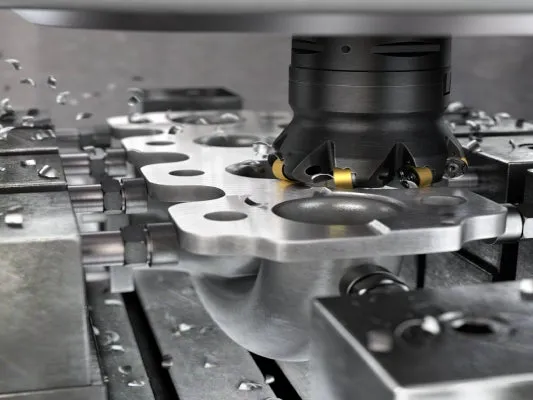
Face milling cutters are widely used in the following scenarios due to their high efficiency and wide cutting area:
●Large-area flat surface processing, such as the end faces of mechanical parts, mold bases, etc.
●Rough and semi-finishing of various metal materials such as steel, aluminum alloy, etc.
●Industrial manufacturing with large production batches and high-efficiency material removal.
●High-speed milling operations on machine tool processing centers.
●Face milling cutters are suitable for situations where high processing efficiency and repeatability are required, especially in the automotive, aerospace, mold manufacturing and other industries.
Advantages of face milling cutters
High Efficiency: Multiple blades cut simultaneously, greatly improving material removal rate and shortening processing time.
Stable Surface Quality: Reasonably designed blade arrangement and geometry help to ensure the flatness and roughness of the machined surface.
Wide Range of Applications: Suitable for processing a variety of metal materials, especially workpieces with medium and high hardness.
Long Tool Life: Made of high-quality carbide blades, they are wear-resistant and high-temperature resistant, suitable for high-speed cutting.
Easy to Replace: The blade can be removed and replaced, reducing the overall tool cost.
Disadvantages of face milling cutter
High rigidity requirements for machine tools: Vibration is easily generated under high speed and large feed, and the machine tool needs to have strong rigidity; otherwise, the processing quality will be affected.
High tool cost: High-quality face milling cutters and inserts are expensive, requiring a large initial investment.
Blade wear affects processing quality: If one of the multiple blades is severely worn, it may lead to uneven surface quality.
Not suitable for super finishing: For parts that require a mirror effect or an extremely high finish, face milling cutters may not achieve the expected results.
Complex adjustment: Blade installation and adjustment require high operating skills. Improper installation can easily cause tool damage or processing defects.
What is a Flying Cutter?
The fly cutter is a simple yet practical milling tool, primarily used for processing high-finish planes, especially suitable for soft materials such as aluminum alloys, copper, and plastics.
The structure of the Flying Cutter
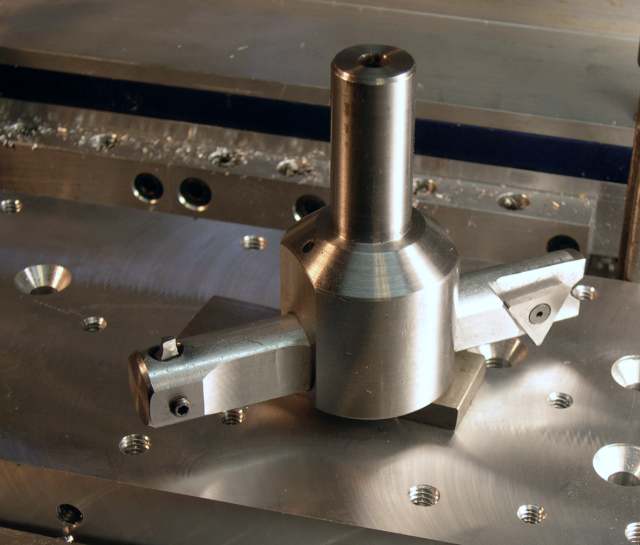
Fly cutters usually consist of a shank (cutter body) and one or two replaceable blades. The blade is installed at the end of the shank, protruding from the edge of the cutter body, and uses centrifugal force to cut. The shank can be selected in different lengths and rigidities according to processing requirements, and sometimes it can even be customized. The blades of flying cutters are mostly made of carbide materials, and some high-end applications also use diamond blades to improve processing life and surface quality. Its structure seems simple, but it has high requirements for blade angle, extension length, installation stability, etc. Any slight deviation may cause vibration or an uneven surface.
Flying Cutter processing method
During fly cutting, the single tip of the tool slowly sweeps across the workpiece surface in a rotating manner. Since there is only one cutting point, the cutting load is small, which is suitable for low-speed and light-load processing environments.
During the machining process, the flying cutter is usually used for finishing, with a slow feed speed and a shallow flying cutter depth (generally less than 0.5mm), which is suitable for occasions requiring high flatness and smoothness.
Common Uses

●Mirror surface processing of soft metals such as aluminum alloy, copper, stainless steel, etc.
●High finish treatment of mold parting surface, shell panel, and other appearance parts.
●Prototype proofing, small batch finishing projects.
●Single or low-volume part processing on benchtop milling machines and vertical milling machines.
●CNC engraving machines, surface finishing of low-power equipment.
Advantages of Flying Cutter
Extremely High Surface Finish: Can reach Ra0.2 or lower, close to mirror effect.
Simple Structure and Low Cost: The tool bar and blade are easy to process and replace.
Flexible Adjustment: Cutting angle and tool position can be flexibly adjusted to suit different tasks.
Suitable for Low-speed Machine Tools: It does not rely on high speed and is also applicable to traditional milling machines.
Reduce Cutting Force Fluctuations: The single-edge design avoids the cutting interference problem of multi-edge tools.
Disadvantages of Flying Cutter
Low Machining Efficiency: Since there is only one cutting point, the material removal rate is slow.
Susceptible to Vibration: When the tool bar is long or the extension is large, it is easy to have jitter or harmonic problems.
High Operating Technology requirements: The height of the tool tip and cutting parameters need to be accurately adjusted; otherwise, tool marks are likely to appear.
Not Suitable for hard metals or mass production: The efficiency is low when processing high-hardness materials or when used continuously for a long time.
The core difference between face milling cutters and flying cutters

Is that both can be used for plane machining, but there are essential differences in structure, machining performance, efficiency, cost, etc. The following is a core comparison between the two to help you make a reasonable choice based on actual machining needs.
Cutting method comparison
The face milling cutter uses multi-edge cutting. Multiple blades are involved in cutting at the same time in each rotation. The cutting path is dense and suitable for large-area rapid processing. This method has obvious advantages in the rough processing stage, which can efficiently remove materials and improve processing efficiency. The flying cutter uses single-edge cutting and relies on a blade to sweep the entire workpiece surface for processing. Although the efficiency is lower, the cutting path is longer, which is conducive to dispersing heat and reducing surface defects, so it has more advantages in fine processing.
Processing performance comparison
From the perspective of processing stability, face milling cutters can still maintain good balance and stability at high speeds, and are suitable for processing high-strength materials such as steel and stainless steel. Fly cutters are prone to imbalance at high speeds, especially when the blade is extended too long or the clamping is unstable, which can easily cause vibration. Therefore, they are more suitable for finishing soft materials such as aluminum, copper, and plastic.
Comparison of machining speed and metal removal rate
Multi-edge face milling cutters can run at high speeds and with large feed rates, so they have high metal removal rates and fast processing rhythms, making them suitable for mass production and large-sized workpieces. In contrast, single-edge cutting with a fly cutter requires more conservative speeds and feeds to prevent chattering or chipping, which results in slower processing speeds and less material removal, making them more suitable for small batches or surface treatment stages.
Comparison of machined surface finish
In terms of surface quality, the flying cutter is superior. Its single-edge structure makes each cut smoother, and the tip of the tool passes through more areas and has dense tracks, which can achieve an excellent mirror effect. It is often used in the last process before mold polishing. Although the multi-edge structure of the face milling cutter has high processing efficiency, it is easy to leave subtle tool marks or steps at the intersection of the blades, and the surface finish is slightly inferior. Of course, by using high-precision blades and optimizing parameters, the face milling cutter can also achieve a good surface effect, but it is not as good as the "mirror" level processing of the flying cutter.
Requirements for machine tool power and rigidity
Face milling cutters have high requirements for the power and overall rigidity of the machine tool spindle. Because there are multiple blades cutting at the same time, the cutting force is large. If the equipment is not rigid enough, it is easy to cause vibration, blade chipping, and even workpiece scrapping. Flying cutters have relatively low power requirements and are suitable for light or medium-sized machine tools. However, it should be noted that the flying cutter shank is long and the blade extends a lot, so the shank rigidity requirements are high; otherwise, it will also cause vibration. Therefore, no matter which tool is used, the parameters must be reasonably adjusted according to the machine tool performance and clamping method.
Cost, life, and maintenance differences
In terms of cost and maintenance, the initial investment of face milling cutters is high, especially the combination of cutter body multiple carbide blades is expensive. However, the blades are replaceable, have a long service life, and the maintenance and replacement costs are controllable. Fly cutters have a simple structure, a low price for a single cutter, and a low overall investment, but the blades wear quickly, have a short service life, and require high technical skills from the operator, making them difficult to manage in a standardized manner.
|
Comparison Dimensions |
Face Milling Cutter |
Flying Cutters |
|
Cutting Method |
Multiple cutting edges at the same time, dense cutting paths |
Single-edge cutting, long and continuous path |
|
Applicable Processing Stage |
Roughing |
Finishing |
|
Processing Stability |
Good balance at high speed, suitable for high-strength materials |
High speed and easy vibration, suitable for soft materials |
|
Applicable Materials |
Hard materials such as steel and stainless steel |
Soft materials such as aluminum, copper, plastic, etc. |
|
Processing Speed |
High speed, large feed, high metal removal rate |
Low speed, conservative feed, slow speed |
|
Surface Finish |
There may be knife marks left |
Dense tracks, mirror effect |
|
Machine Tool Requirements |
High-power, high-rigidity machine tools |
Low power requirement, but high tool bar rigidity is required |
|
Cost and Lifespan |
High initial cost, but long blade life |
The tool cost is low, but it wears quickly and needs to be replaced frequently. |
|
Maintenance Difficulty |
Standardized replacement blades, easy maintenance |
High maintenance flexibility due to operator skills |
|
Typical Applications |
Batch rough machining, large-sized workpieces |
Mold polishing, precision surface processing |
How to choose the right cutter
Should you use a face mill or a flying cutter? There is no absolute standard answer. The key depends on your processing materials, processing requirements, machine tool capabilities, and cost budget. The following are some common selection suggestions to help you make a more confident judgment.
Processing materials
For steel, stainless steel, or high-hardness metal materials, it is recommended to give priority to face milling cutters. Multi-edge cutting can effectively reduce the load per tooth and improve processing efficiency. At the same time, the blade material is more suitable for high-intensity cutting. For soft materials such as aluminum alloy, copper, plastic, resin, etc., flying cutters have more advantages. They cut lightly, are not easy to produce burrs, and are easier to obtain high surface finish.
Surface quality requirements
If the requirements for surface roughness are particularly high, such as prototype parts, shell parts, or mold surfaces that need to be close to mirror effects, a flying cutter is a more suitable choice. Due to its single-edged, continuous cutting characteristics, the flying knife can reduce the overlapping lines on the surface and avoid the "step feeling", thus obtaining a smoother surface. On the contrary, if the surface finish requirement is not high and the processing efficiency is more important, then the face milling cutter is sufficient.
Efficiency and capacity requirements
If large quantities of parts need to be processed quickly, such as automotive parts, structural parts, etc., it is recommended to use a face milling cutter. It has a multi-tooth structure, which can greatly improve the material removal rate per unit time and significantly shorten the processing cycle. Flying cutters are more suitable for small batch or precision trial production scenarios, and are not suitable for high-intensity, high-beat processing tasks.
Machine tool performance judgment
The power and rigidity of the CNC machine are also important factors in determining the choice of tool. Face milling cutters usually require stronger spindle power and rigidity support for the advantage of high efficiency. If you are using a small or medium-sized vertical machining center with low power or unstable structure, then a flying cutter is more suitable, as it has a smaller cutting load and relatively loose requirements on the equipment.
Cost control and maintenance convenience
Cost control during tool purchase and use, the flying cutter has a simple structure, cheap blades, and is easy to replace, which makes it very suitable for budget control. Although the face milling cutter is efficient, the overall tool and blade prices are high, and the maintenance cost is higher. If you have a sufficient budget to pursue high efficiency, the face milling cutter is worth investing in; if you focus on cost-effectiveness, the flying cutter is a good choice.
summary
Face milling cutters and flying cutters each have their advantages and disadvantages, and are suitable for different processing needs. Face milling cutters use multi-edge cutting, which is highly efficient and suitable for large-scale rough processing of hard materials such as steel and stainless steel. They have high requirements for machine tool rigidity and are relatively expensive; flying cutters mainly perform single-edge cutting, which can achieve excellent surface finish. They are especially suitable for small-batch finishing of soft materials such as aluminum alloys and plastics. They are flexible in processing, have low equipment requirements, and have good cost control. When choosing, a comprehensive evaluation should be made based on the processing materials, surface quality requirements, production capacity targets, and machine tool performance. If you pursue efficiency and production capacity, it is recommended to use a face milling cutter; if you pay more attention to surface quality and cost-effectiveness, a flying cutter would be a wiser choice. Understanding the core differences between the two is the key to improving processing results, controlling costs, and meeting customer needs.