


If you work in machining or manufacturing, then you have probably heard of end mill cutters. So, what exactly is an end mill cutter, and why is it so important in precision machining? An end mill cutter is a cutting tool used on a milling machine to remove material from a workpiece. They come in a variety of shapes and sizes, each designed for a specific cutting task. Whether you are machining flat surfaces, complex 3D contours, or special shapes, selecting the right end mill cutter can lead to significant improvements in quality and efficiency.
In this guide, we will take a deep dive into the world of milling and learn what an end mill cutter is, how it works, and its applications. By reading on, you will have a clearer understanding of the importance of these tools in the manufacturing process and how to improve your work accuracy and performance by choosing the right end mill cutter.
The meaning of end mill cutter
An end mill cutter is a versatile cutting tool that is widely used on milling machines to remove material from a workpiece. Unlike a drill, which can only move in a straight line, a milling cutter can move in multiple directions, which makes it ideal for precision cutting in a variety of materials such as metal, plastic, and wood. The design of an end mill cutter typically includes cutting edges on the side and tip, which allows it to make both horizontal and vertical cuts.
In CNC machining, end milling cutters are often used for high-speed and high-precision tasks. These tools are essential for machining metals, plastics, and composites, providing the precision and accuracy that meet the needs of modern advanced manufacturing.

Features of end mill cutters
End mill cutters have a variety of different features that make them suitable for a variety of tasks. Here are some of the main ones:
Cutting Geometry: The cutting geometry of an end mill cutter includes flute design, helix angle, and number of flutes. These features affect cutting efficiency, chip evacuation, and surface finish. The more flutes an end mill cutter has, the smoother the surface finish, but it generally removes material more slowly.
Material Composition: End mill cutters are made of different materials according to different working requirements. Common materials include high-speed steel (HSS), cemented carbide, cobalt alloy, nd powder metallurgy. Each material has different hardness, wear resistance, and heat resistance, which affect the service life and applicability of the end mill cutter.
Coatings: Many end mill cutters have coatings on their surfaces to enhance their performance and durability. Common coatings such as titanium nitride ( TiN ), titanium nitride carbide ( TiCN ), and diamond-like carbon (DLC) can significantly increase tool life, reduce friction, and enhance cutting performance by improving heat resistance and wear resistance.
Flute Design: Flutes are grooves on the side of the end mill cutter that help evacuate chips during cutting. The number and design of flutes vary depending on the type of material being cut and the processing requirements. A higher number of flutes generally produces a smoother surface but may reduce material removal efficiency.
Tool Length and Diameter: End mill cutters are available in a variety of lengths and diameters to accommodate different cutting depths and geometries. Long tools are used for deep cuts, while short tools provide better stability and accuracy for shallow cuts.
The basic structure of the end Milling cutter

The end mill cutter is used to achieve the best cutting performance. The basic components of the end mill cutter include:
Shank: The shank is the part of the end mill cutter that is fixed in the tool holder. It needs to be strong and rigid enough to withstand the various forces during machining. Shanks come in different sizes to suit different tool holders and machine tool requirements.
Slots: Slots are grooves cut into the side of the end mill cutter to help with chip evacuation. The number and design of slots may vary, and the appropriate design is selected based on the material being cut and the processing requirements.
Cutting Edge: The cutting edge is located at the tip and side of the end mill cutter and performs the actual cutting operation. The sharpness of the cutting edge directly affects the machining accuracy and surface finish.
Neck: The neck of an end mill cutter is the portion between the shank and the cutting section. It allows for adequate clearance when making deep cuts. In some milling cutters, the neck is reduced in diameter to allow access to tight spaces or cavities.
Cutter Head: The cutter head is the top part of the end mill cutter, which does the main cutting. Depending on the design, the cutter head can be flat or have a radius to suit different machining tasks, such as contour milling or curve machining.
Working principle of end mill cutter
End mill cutters work by rotating at high speeds and in contact with the workpiece. The cutting edge gradually removes material by shearing small particles of material to achieve the desired shape or surface finish. Depending on the operation, the end mill cutter may move along a horizontal, vertical, or 3D path. The direction and speed of the cut depend on the material being machined and the type of milling operation being performed.
Applications of Milling Cutters
End mill cutters have a wide range of applications in many fields, from flat machining to complex 3D contour milling. They are ideal for face milling, slotting, and contouring, and are particularly important in industries such as aerospace, automotive, and metalworking. End mill cutters are also essential for making molds, die machining, and prototyping because of their ability to provide highly accurate machining. Whether machining metal, plastic, or wood, choosing the right end mill cutter is key to ensuring high-quality results.
Types of end mill cutters and their applications
There are many types of end mill cutters, each designed for specific cutting tasks and materials, ensuring your machining projects are done with high precision and efficiency. Here are some of the most common types of end mill cutters and their applications:
1. Flat head end mill cutter

Flat-nose end mill cutters are the most common type and are used primarily for surface finishing, grooving, and contouring. Their cutting edges are flat, creating smooth, even surfaces. They are often used for general milling tasks, but are particularly suited for face milling, which involves making parallel cuts on the workpiece surface.
Application: Universal milling cutter for surface finishing, grooving, and contour milling.
2. Ball nose end mill cutter
Ball end mill cutters have rounded tips and are ideal for 3D contouring, cavity machining, and cutting complex shapes. Their rounded cutting edges allow for curved surfaces and edges, making them ideal for mold making and cavity machining. Ball end mill cutters provide precision curved surface machining in the machining of automotive and aerospace parts.
Application: A powerful tool for 3D surface processing, suitable for molds, aviation, and precision milling of complex shapes.
3. Corner radius end mill cutter
The radius end mill cutter has a rounded tip shape, which combines the advantages of flat end mill cutters and ball end mill cutters. Radius end mill cutters are very suitable for chamfering, radius cutting, and finishing of stress-free corners. This milling cutter is often used to manufacture components that require smooth radius or transition edges, which is very common in structural parts.
Application: Specially used for rounded corners and chamfering, taking into account the advantages of both flat heads and ball heads, suitable for finishing transition edges.
4. Rough end mill cutter
Roughing end mill cutters, also called roughing end mill cutters, are designed to remove large amounts of material quickly. Their unique tooth structure enables them to cut deeper and faster than traditional milling cutters. Roughing mills are usually used in the early stages of machining to quickly remove most of the material, leaving a rougher surface, which can then be used with finer milling cutters for subsequent finishing.
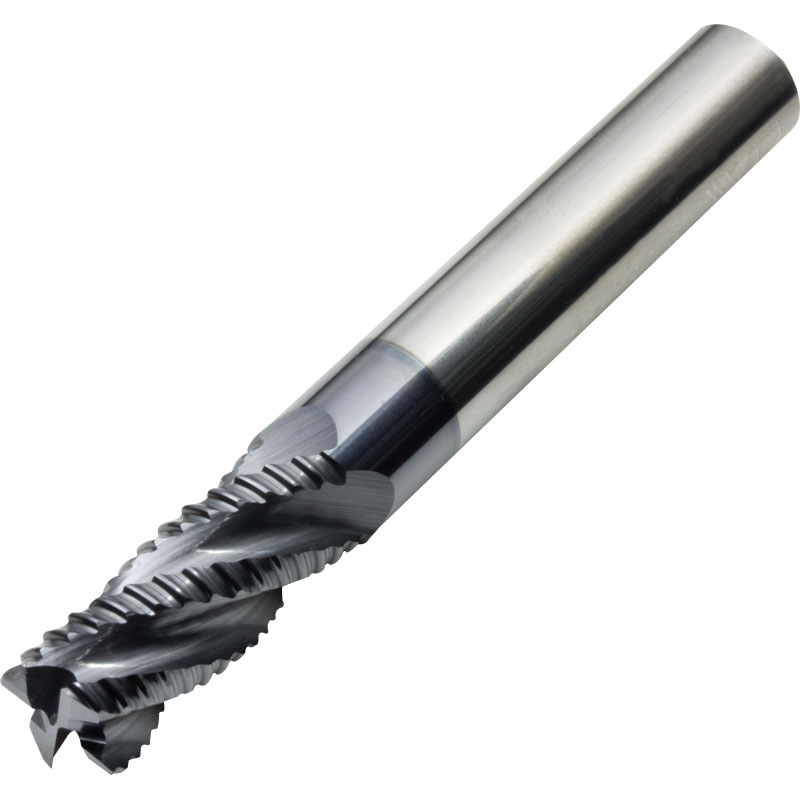
Application: The first choice for efficient material removal, used for rapid rough machining, and reserves margin for subsequent finishing.
5. Tapered end mill cutter
Tapered end mill cutters have a tapered body that enables them to access deep holes or contours. These mills are often used for angled cutting, deep hole machining, and creating tapered holes or wedge-shaped cavities. They are often used in mold making and are also used to create aerospace and automotive parts that require angled features.
Application: Deep hole and taper processing expert, suitable for mold and angle feature cutting.
6. Thread end mill cutter
Thread end mill cutters are end mill cutters specifically designed for cutting internal and external threads. Unlike traditional taps, thread end mill cutters can process threads of different sizes and pitches, giving them greater flexibility. They are particularly important in high-precision thread cutting, especially when taps will not work effectively.
Application: High-precision thread cutting tool, flexible to cope with a variety of materials and thread specifications.

Advantages and disadvantages of end mill cutters
Advantages of End mill cutters
Versatility: End mill cutters are very versatile tools that can perform a variety of tasks, whether you are machining flat surfaces, complex shapes, or fine details, end mill cutters can handle it with ease.
Multi-Directional Cutting: Unlike drills, end mill cutters can cut both vertically and horizontally, making them excel in complex three-dimensional machining and machining of intricate part geometries, which is critical to the aerospace and automotive industries.
Precision and Surface Finish: End mill cutters have sharp cutting edges and multiple flutes, which can provide precise cutting and a high-quality surface finish, suitable for tasks that require high precision and smooth surfaces.
Efficiency: End mill cutters are designed for high-speed machining and can quickly remove material, especially when working under the correct cutting parameters. This greatly improves production efficiency and can shorten machining cycles.
Tool Life: Many end mill cutters are made of durable materials such as carbide to handle tough materials and high cutting speeds. Some end mill cutters are also coated to increase their resistance to heat and wear, thereby extending tool life.
Disadvantages of End mill cutters
Limited Cutting Depth: While end mill cutters are good for shallow cuts, they may not be the best choice for deep hole drilling or cutting very deep slots. The length and diameter of the tool will limit the effective depth of cut.
Tool Wear: Although end mill cutters are very durable, they still wear out under high-speed and heavy-load cutting conditions. Regular maintenance and tool replacement are essential to maintain performance.
Higher Cost: High-quality end mill cutters, especially those made of carbide or coated with advanced coatings, are usually more expensive. Although they provide longer life and better performance, the initial investment may be more expensive than other cutting tools.
Chip Evacuation Issues: End mill cutters may face chip evacuation issues during high material removal rate machining. If the chips are not removed effectively, they may damage the workpiece or tool, reducing machining efficiency and quality.
Application Specificity: While an end mill cutter is versatile, it may not be the best tool for certain applications. For extremely specific tasks, other tools such as drills or reamer may be more efficient.
How to choose the right end mill cutter
Selecting the right end mill cutter is critical to achieving the best machining results, efficiency, and surface quality. The wrong choice can lead to poor machining results, increased tool wear, and increased costs.
When selecting an end mill cutter, several key factors affect its performance:
1. Material: The material of the end mill cutter determines its hardness and durability. High-speed steel is suitable for machining soft materials such as aluminum, while cemented carbide is suitable for machining hard materials such as steel and titanium. For high-temperature applications, cobalt alloy end mill cutters have better high-temperature resistance.
2. Coating: TiN or TiAlN coating helps reduce friction, increase tool life, and enhance cutting performance. If you need to process high-temperature materials or require higher durability, choosing a coated milling cutter will have a significant effect.
3. Size: The diameter of the end mill cutter depends on the size of the material you are processing and the type of cutting required. Larger diameters are generally used for heavy-duty cutting, while smaller diameters are better suited for fine or intricate machining details.
4. Number of Flutes: The flutes on an end mill cutter are spiral grooves that help remove cuttings. Fewer flutes are suitable for deep cutting and rapid material removal, while more flutes provide finer surface processing and are suitable for light cutting and precision machining.
What should I pay attention to when using an end mill cutter?
When using an end mill, there are several key factors to consider to ensure optimal performance and avoid damaging the tool or workpiece. Here are a few areas to focus on:
Choosing the Right Tool
Choosing the right end mill for your material and machining task is critical. Consider the material you are machining, the type of cut, and the shape of the workpiece. Using the wrong end mill can result in poor machining results and premature tool wear.
Cutting Speeds and Feeds
The correct cutting speeds and feeds are critical to achieving the best results. Too fast a speed or feed rate can cause excessive wear, vibration, or overheating, while too slow can result in inefficient cutting. Always check the recommendations for the material you are machining to find the best balance.
Tool Alignment
Make sure the end mill is properly aligned in the CNC machine. Improper alignment can result in uneven cutting, poor surface finish, and even damage to the tool. Always check the position of the tool before you start cutting to avoid problems during the machining process.
Chip Evacuation
Effective chip evacuation is essential to maintaining cutting performance and preventing tool damage. If chips accumulate around the tool, it can cause heat to build up, causing tool wear or even breakage. Use the right coolant and adjust cutting parameters to promote efficient chip evacuation.
Monitor tool wear
Regularly check for signs of tool wear, such as blunt or obvious damage to the cutting edge. Blunt or worn end mills not only affect cutting quality but also increase the risk of damaging the workpiece. Timely replacement or grinding of tools ensures better precision and longer tool life.
Use coolant

Depending on the material and cutting conditions, using coolant can help maintain the temperature of the tool and workpiece, reduce friction, and prevent heat buildup. This not only extends tool life but also improves cutting efficiency and surface finish.
Summarize
In summary, milling cutters are vital and versatile tools for a wide range of machining tasks, providing precision and efficiency in a wide range of materials and cutting techniques. Whether you're machining flat surfaces, complex shapes, or fine geometries, choosing the right milling cutter can significantly improve the quality of your work. From flat end mill cutters and ball end mill cutters to roughing and tapered mills, each milling cutter is designed for a specific application.
For best results, it is important to consider factors such as tool selection, cutting speeds, feed rates, and ensuring smooth chip evacuation. Regularly checking tool wear and using appropriate coolant can effectively extend tool life and maintain high cutting efficiency. By following these operating recommendations, you can ensure a smoother machining process, improve the overall quality of your work, and achieve better milling results.