


End mills are essential cutting tools in machining as they are used to remove material from a workpiece with precision. Drill bits only cut vertically, while end mills can cut in multiple directions. That is why they are widely used in tasks including profiling, contouring, slotting, and plunging. Their versatility makes them useful in both manual as well as CNC milling machines.
Among all types of End mills, carbide end mills are the industry standard for high-performance applications. They are made up of hard tungsten carbide, which makes them highly durable, heat-resistant, and cutting. Such qualities are useful while working with tough materials like stainless steel, titanium, and cast iron. They have wide applications in multiple industries, including automotive, aerospace, die-making, and precision engineering.
In this article, you will learn what carbide end mills are, how they're different from drills, the various types and shapes they come in, their benefits, applications, and more.
End Mills vs Drills

While both drills and End mills are used in machining as cutting tools, they differ in design and functionality.
A drill bit cuts straight down into a material that creates a round hole by removing material axially.
On the other hand, an end mill cuts in multiple directions axially and radially, which makes it useful for slotting, contouring, profiling, pocketing, and other operations.
Both of these also differ in design. Drills have a pointed tip and spiral flutes for chip removal, while end mills have cutting edges on both sides and ends, with a flat or round tip depending on the type.
End mills are made up of different types of materials, including:
HSS: They are ideal for soft materials but wear quickly at high speeds.
Cobalt: They are suitable for relatively harder materials and are heat-resistant, unlike HSS.
Carbide: They are best suited for high-speed machining and hard materials, such as stainless steel, cast iron, and titanium.
All of these types differ in their applications, and a machinist chooses one based on the job's requirements.
Types of Carbide End Mills
Carbide end mills come in various types, and each type is used for specific cutting tasks. Choosing the right type enhances efficiency and improves the longevity of the tool. Let's explore the commonly used five types of carbide end mills.
V-Bit Carbide End Mills
The V-bit type carbide end mills are used for V-carbing and are available at either 60° or 90° angles. End mills with sharp tips are intended for cutting narrow paths. Due to its rounded edges and corners, this end mill is ideal for machining edges and corners that are particularly sharp.

Spiral carbide end mills
Spiral carbide end mills are used for milling up-cuts as well as down-cuts. Up-cut carbide end mills are suitable for clearing chips quickly and keeping the cutting edge cool, which makes them suitable for high-speed machining on materials like aluminium.
On the other hand, down-cut carbide end mills push material down during the cut, which helps maintain a clean surface finish. So, they are useful when surface finish or part stability is critical.

Straight flute Carbide End Mills
The straight flute carbide end mill has a single-end, zero degrees helix, and straight and basic flutes. The straight flute reduces the fraying of a workpiece's edges and provides a good surface finish. The milling of composites of epoxy and glass can be done with these machines, as well as profile milling.
Roughing Carbide End Mills
Metal chips on a workpiece are broken into smaller pieces by roughing carbide end mills with scallops on the outside diameter. A given radial depth of cut is thus accomplished with lower cutting pressures. When large quantities of material need to be removed, roughing end mills are mainly used for rough milling.
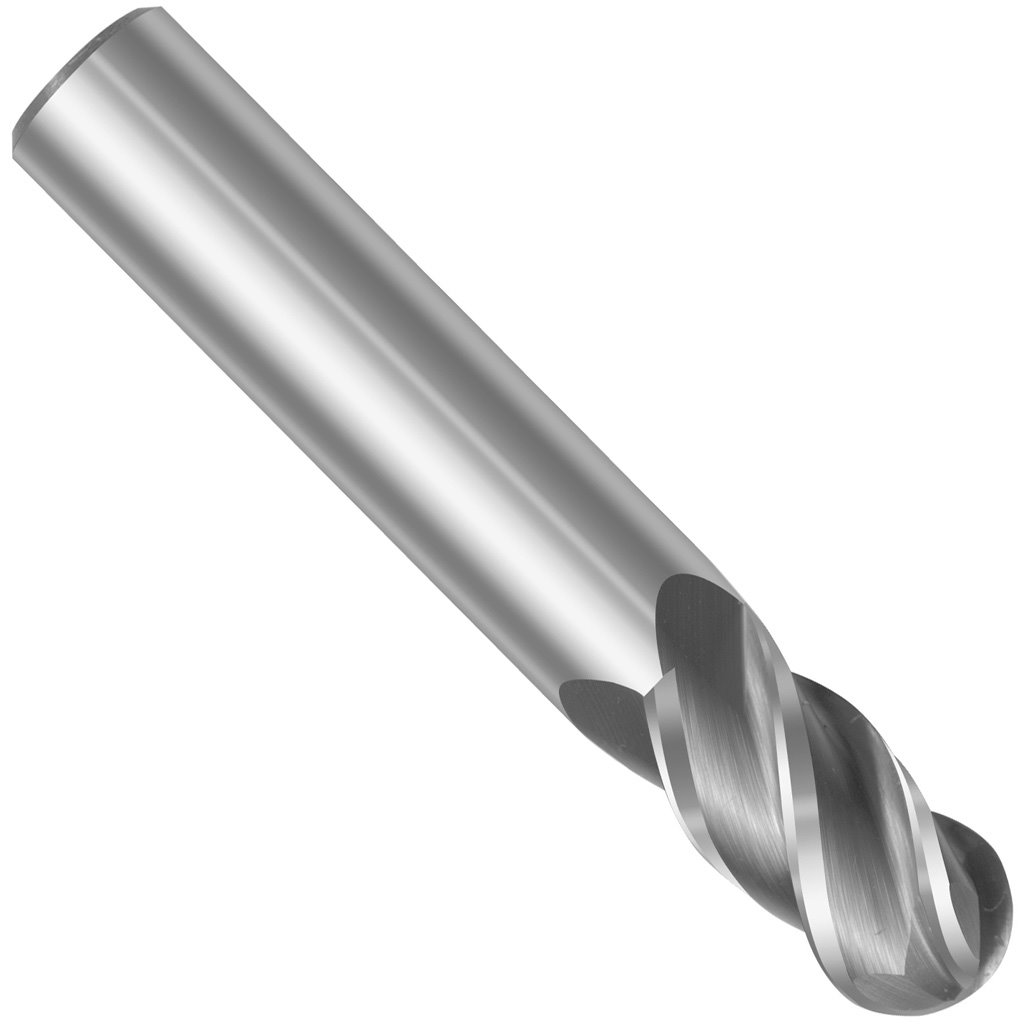
Ball-nose Carbide End Mills
They are also known as ball end mills, as their tips are round-shaped. These can be single-ended or double-ended. Ball nose end mill can use general-purpose geometries or have high-performance ones. These cutters are used to mill large corner radii, grooves with full radii, and mill contours or profiles.
Benefits of Using Carbide End Mills
Carbide end mills offer many advantages that make them highly demanding in machining applications. A few of them are listed below:
Hardness and Heat Resistance
As they are made up of tungsten carbide, which is harder than other materials, HSS, and cobalt, this gives them an edge to withstand high temperatures without affecting the performance.
High cutting Speeds and Feed rates
Due to rigidity and heat resistance, carbide end mills run at higher RPMs and feed rates. This quality helps remove material faster, improving efficiency and reducing machining time, which is useful when high production volumes are required.
Tool longevity
Although carbide end mills are expensive, they have a longer life than HSS or cobalt end mills. This helps reduce downtime and lower long-term tool costs.
Ideal for Hard materials
Carbide end mills are best for machining hard materials like stainless steel and cast iron. This strength makes them useful for aggressive cuttings where other tools could wear out.
Useful in High-performance industries
As they are highly durable, they are widely used in automotive, aerospace, medical, and mold-making industries, as they are used to cut tough materials with high accuracy.
Applications of Carbide End Mills
CNC Machining
Carbide end mills are crucial in CNC machining as they offer excellent precision, speed, and consistency. They can withstand high speeds and feed rates that make them useful in carrying out automated milling, drilling, facing, and pocketing operations. Their hardness makes them essential for tasks that require roughing or finishing.
Automotive and Aerospace Industries
In industries like automotive and aerospace, where machining of tough materials is required, carbide end mills are an excellent choice. They are used to machine titanium alloys and hardened steels. As they offer high speed even at high temperatures, they are used for high-accuracy tasks that also require precision.
Commonly, they're used to produce engine parts, structures of automobiles, and high-precision assemblies.
Mold and Die Making
The mold and die industries, just like other high-precision industries, use precision and accuracy of hard materials. They are used for shaping molds, cavities, and cores due to their long tool life and ability to maintain sharp cutting edges even in tough materials.

Useful in Engraving, Slotting, and Grooving
Carbide end mills are best for cutting narrow slots, engraving detailed patterns, and performing grooving in metals and composites. Their sharp tips and rigidity provide accurate results without chipping.
Contouring and Profile Milling
Carbide end mills are used for 3D contouring and complex profile machining as they provide smooth finishing. They are used in tool and die shops, metalworking, and precision part manufacturing, where detailed geometry is essential.
How to Choose the Right Carbide End Mill
In machining, choosing the right carbide end mill is one of the most important steps. The fact that every tool has different geometries, each crucial to the outcome on your part, complicates the process. During the tool selection process, we recommend that you keep the following points in mind.
Material You are cutting
Knowing what materials and properties you will be working with will help narrow down your end mill selection. The mechanics of each material differ as they exhibit different characteristics when it comes to machining. Different machining strategies are required for plastic materials, for example, as well as different tool geometries. Tool performance and longevity will be improved if you choose a tool with geometries suited to those unique characteristics.
Tool Dimensions
Suppose you wish to accomplish the milling operation you need. In that case, you will need to take into consideration the dimensions of the tool, including the cutter diameter, the length, and the profile of the tool.
Tool Profile
Carbide end mills can be classified into three main types of shapes, namely square, corner radius, and ball end. There are sharp 90° corners on both ends of the flute on the square profile on the end mill, ideal for creating precise, square-edged cuts. By replacing a sharp corner with a radius, a corner radius profile increases strength, prolongs tool life, and prevents chips. Another type of fluted profile is the ball profile, which features straight flutes with a rounded end, thus creating a "ball nose" at the tip of the tool. It is considered to be the strongest type of fluted profile.
Cutter Diameter
The dimension that will define the width of a slot or the amount of material to be removed by the radial depth of cut when side milling. Selecting a cutter diameter that is the wrong size, either too large or too small, can lead to the job not being completed successfully or a final part not being to specifications.
Length of Cut & Reach
The longest contact length during operation should dictate the length of the cut for any end mill. The cut length should not exceed the required length. A tool that is as short as possible will result in a reduced overhang and less chatter when being used. When cutting at a depth greater than 5x the tool diameter, it may be better to explore necked reach options as opposed to long length cuts.
Carbide End Mill vs HSS vs Cobalt
Let's take a look at the difference between carbide end mills, HSS, and Cobalt in detail.
|
Feature |
Carbide End Mill |
HSS End mill |
Cobalt End Mill |
|
The material they're made up of |
Tungsten carbide and cobalt binder |
Alloy of steel with tungsten, chromium, and vanadium |
HSS with 5 to 8% cobalt content |
|
Hardness |
Very high |
Moderate |
Higher than HSS, but less than carbide |
|
Heat resistance |
Up to ~1000°C |
Up to ~600°C |
Up to ~800°C |
|
Cutting speed (RPM) |
High |
Low to moderate |
Moderate to High |
|
Tool life |
Longest |
Shorter |
Longer than HSS but shorter than carbide |
|
Cost |
Highest |
Lowest |
Moderate |
|
Best For |
Hard materials like stainless steel, titanium, etc |
Softer materials (aluminum, mild steel, plastics) |
Tough materials (alloy steels, cast iron) |
|
Durability |
Very brittle, can chip under vibration |
Tough, less prone to chipping |
Better toughness than carbide |
|
Surface Finish |
Excellent |
Average |
Good |
|
Ideal Usage |
High-speed CNC, precision work |
General-purpose machining |
Heavy-duty cutting with better heat resistance |
Maintenance And Best Practices
Regrinding Options
Carbide end mills can often be reground to restore their cutting edges. Regrinding extends tool life and lowers overall tooling costs.
For best results, regrind before excessive wear or chipping affects the tool geometry.
Proper Storage
Always store carbide end mills in individual cases to prevent them from touching each other. Even small impacts can cause micro-chipping on the cutting edges, reducing effectiveness and accuracy.
Coolant and Lubrication

Use high-quality coolant to reduce heat buildup and improve chip evacuation. This helps prevent premature tool wear and enhances surface finish. For demanding operations or hard materials, coolant becomes even more essential.
Cleaning
After using the tool, clean the tool thoroughly to remove any buildup. This keeps them away from contaminants and prepares the tool for the next job without wear.
If you follow all of these practices carefully, they will not only increase the lifespan of the tool but also maintain precision and accuracy.
Conclusion
Carbide end mills are an excellent choice and the most commonly used end mills in the machining industry. They withstand heat resistance, are durable, and maintain accuracy at even high speeds and feed rates.
Whether you're cutting cast iron or stainless steel, carbide tools provide accurate results. That is why machinists select them for cutting in the high-performance industries, including aerospace, automotive, and mold making.
As carbide end mills have different types and geometries so understanding their usage is important to maximize productivity without impacting the accuracy.
If you're someone looking to upgrade your machining tools or source high-quality end mills, look no further, as Great CNC Machine has you covered. From wide precision-engineered tools to industry expertise, they are the trusted partner for all your machining needs.